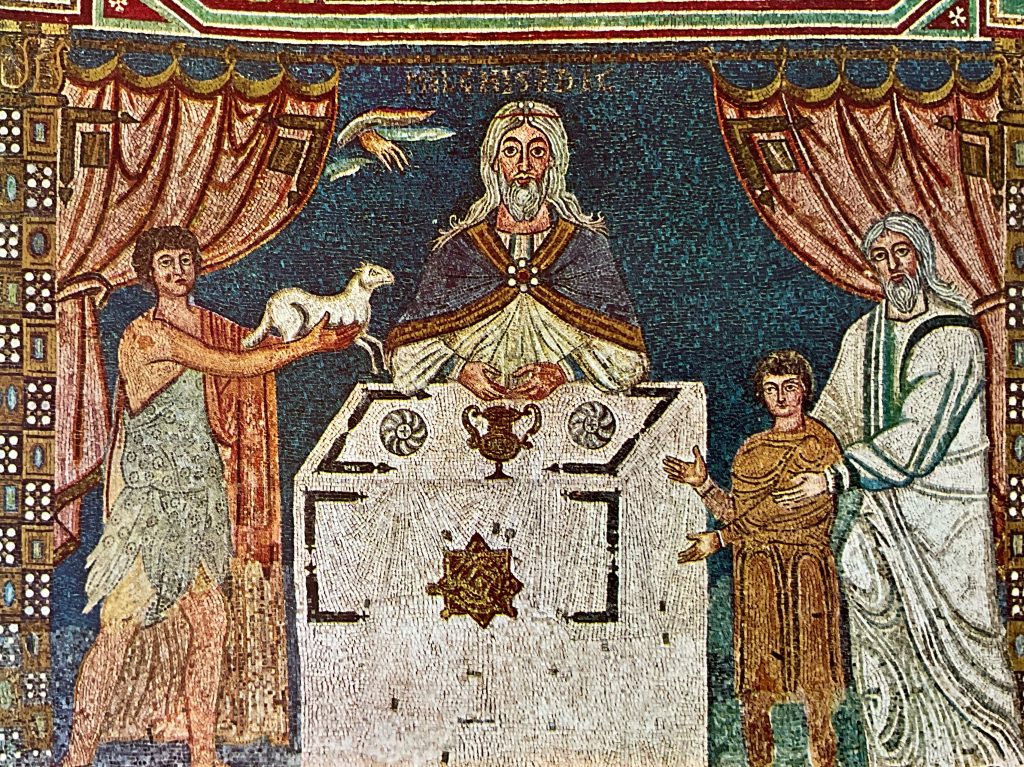
The writer of Hebrews notes in today’s section the mysterious figure of Melchizedek described in the Old Testament as offering bread and wine and giving Abraham a tenth of his possessions. I once visited Ravenna and saw this beautiful 6th century mosaic depicting Melchizedek, Abraham and Abel foreshadowing the action of the Mass. Today’s priests recall Calvary for us, just as Melchizedek anticipated it. They invite our own self-offering to be joined to the indestructible power of Christ’s self offering which is changing the world.
I want to explain the first reading from the letter to the Hebrews which is taken up by the Psalm and centres on the figure of Melchizedek.
In the decades after the resurrection people adopted a pattern of Sunday Eucharist recognising the risen Lord in the breaking of bread lifted them up, inviting us into his own self-offering predicted in the Old Testament.
The writer of the letter to the Hebrews notes in today’s section the mysterious figure of Melchizedek described in the Old Testament as offering bread and wine and giving Abraham a tenth of his possessions.
‘He has no father, mother or ancestry, and his life has no beginning or ending; he is like the Son of God. He remains a priest for ever. This becomes even more clearly evident when there appears a second Melchizedek, who is a priest not by virtue of a law about physical descent, but by the power of an indestructible life. For it was about him that the prophecy was made: You are a priest of the order of Melchizedek, and for ever’.
Christ’s coming at Christmas wasn’t out of the blue but a fulfilment of Old Testament prophecy so that a figure like Melchisedek points us to Christ’s self offering once for all upon the Cross of which this service is a memorial. Christian priests are sometimes said to be ‘of the order of Melchizedek, and for ever’ because Christ’s priesthood is indelible and we bear it, as in another sense each Christian bears Christ.
Years back I went to Ravenna in Italy where there are the Christian mosaics almost 1500 years old dating back to 570 AD. The basilica of St Apollinare in Classehas a fine mosaic which depicts Melchisedek offering bread and wine alongside Abel offering a lamb and Abraham offering his son Show At that time we know the Eucharistic prayer, one we shall use tonight, reminded God of how in pleading Christ’s sacrifice, we seek that he, and I quote ‘Be pleased to look upon these offerings with a serene and kindly countenance, and to accept them, as once you were pleased to accept the gifts of your servant Abel the just,the sacrifice of Abraham, our father in faith, and the offering of your high priest Melchizedek, a holy sacrifice, a spotless victim’.
At Mass we partake from two tables, the table of the word of God as we are doing now, and the altar table, and as we are seeing the two tables hand on nourishment from scripture at the lectern and from the consecration and offering of bread and wine at the altar. As we hear of the figure of Melchisedek this evening may we be given grace to offer ourselves to God as he did thousands of years before Christ ‘our selves, our souls and bodies, to be a living sacrifice’.
The Eucharist is Christ’s sacrifice fulfilling the sacrificial offerings of the Old Testament and inviting our own self offering to move with Christ in his eternal Offering to his Father and our Father. Our prayer tonight is one with those whose lives precede our own upon earth – Abel, Abraham and Melchisedek – and who join with angels and archangels and all the company of heaven at this service.