I wrote a letter to The Times on Monday. It’s a regular mind exercise which sometimes bears fruit in publication. The letter followed reading a report that seeking out wonder and beauty can have a positive medicinal effect. Maria Monroy of Yale University, who conducted the study, said “finding moments of awe in daily life can shift how we view ourselves and our lives overall”. Amen to that – alleluia to that – I thought – and this is what I wrote: ‘Sir. In 1992 I went on a 9 day retreat where the leader invited me to consciously come before God 4 hours a day. At the end the challenging nun suggested I drop down to an hour a day from then on, a practice I have followed with benefit ever since. That de-stressing benefit is just as your article on finding awe suggests (Times, 19 May). By spending time being awed I get schooled towards attending to the important things over the rest of my day. These things are sifted from merely urgent things. John’
I wrote a letter to The Times on Monday. It’s a regular mind exercise which sometimes bears fruit in publication. The letter followed reading a report that seeking out wonder and beauty can have a positive medicinal effect. Maria Monroy of Yale University, who conducted the study, said “finding moments of awe in daily life can shift how we view ourselves and our lives overall”. Amen to that – alleluia to that – I thought – and this is what I wrote: ‘Sir. In 1992 I went on a 9 day retreat where the leader invited me to consciously come before God 4 hours a day. At the end the challenging nun suggested I drop down to an hour a day from then on, a practice I have followed with benefit ever since. That de-stressing benefit is just as your article on finding awe suggests (Times, 19 May). By spending time being awed I get schooled towards attending to the important things over the rest of my day. These things are sifted from merely urgent things. John’
Having written my letter I went up to my Chapel come study and read the readings for Sunday to plan my sermon for Easter 6 at St Mary’s. True to my letter it seemed that the first line of the Gospel verse 23 of John Chapter 14 was important and should be my text – it leaped up at me along with the beginning of verse 27: ‘Those who love me will keep my word, and my Father will love them, and we will come to them and make our home with them… Peace I leave with you; my peace I give to you’.
What also leapt to mind on Monday morning is a sermon heading for today: How do we pray?
I’d shared potentially with the Times readership that prayer, for me, was about being awed by God and how 33 years ago a nun had been the instrument of fixing me to an hour a day before God.
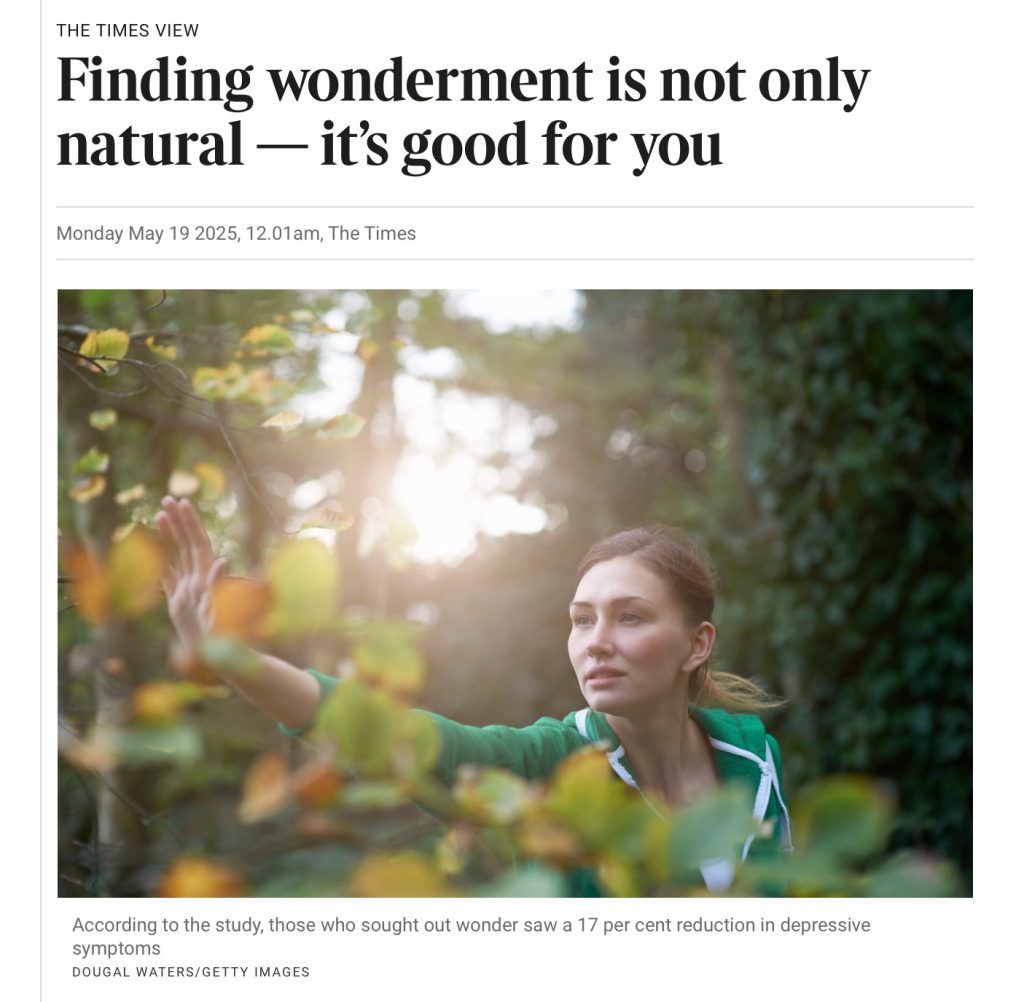
As the Times leading article, picking up on the reported research, concluded, the benefits of seeking out wonder and beauty necessitate finding time: I quote: ‘According to the Yale study, those who sought out wonder saw a 17 per cent reduction in depressive symptoms, a 12 per cent decrease in stress and a 16 per cent increase in wellbeing. Ms Monroy notes that “awe can be found anywhere and everywhere”. So next time the strains of daily life feel a little too much, the answer is not to pick up your phone and doomscroll on social media. Instead it is about seeking out awe, in whatever form it may come. As with the medical benefits of feeling amazed, it is something that merely requires finding the time’.
Friends, the main answer to the question ‘How do we pray?’ is we must find the time – and be assured it needn’t be an hour! It might be 10 minutes. Archbishop Michael Ramsey was once asked how long he prayed and gave a mischievous answer – 2 minutes a day – but it can take half an hour to get there! What the Archbishop meant about prayer is a time when you feel heart and mind are with God which is often a small proportion of the time we actually give to attending to God each day. My own hour is constructed from three components, the first two of which need not be associated with feeling anything. 20 minutes slowly reading through the psalms and bible readings set that day in Common Worship Morning Prayer, 10 minutes slowly pondering a list of names and organisations and prayer cycles and then 30 minutes quiet.
How do we pray? That quiet time for me is constructed with one of four alternating focuses – holding my bible and holding myself to a passage in it, holding attention to the Blessed Sacrament which is the consecrated Bread kept in Church with a light burning beside it, holding attention to the awesome beauty of nature or holding attention within myself, so called centering prayer.
This is a response to the indwelling of God suggested by my text today ‘[the Father and I] will come to [you] and make our home with [you]. Let’s look at each of these four prayer methods.
Bible-based prayer Our relationship with God like any relationship has an objective and a subjective side. God’s invisible but has appointed scripture and sacraments as physical signs of his objective presence. Choose a bible passage, maybe one you heard a sermon on recently, and sit with the Bible on your lap. Pray for the Holy Spirit maybe using the Collect for Purity we use at the beginning of the Eucharist. Slowly read then re-read the passage. Read, mark, learn and inwardly digest. If God seems to underline a word, phrase or sentence stick with it, dwell on it for a few minutes. See if there’s some action being prompted. Resolve to do it some time after praying. Close with thanksgiving maybe saying the Glory be to the Father or Our Father.
Blessed Sacrament prayer Come to Church and sit in the Chapel where the everlasting light burns by the wall safe or Aumbry containing the consecrated Bread kept for Communion of the housebound which is a reminder of God’s objective presence with us through our eating Christ’s Bread and drinking his Cup. Recall the words of the Psalm ‘Be still and know that I am God’. If you can’t get to Church to sit or kneel by the Aumbry call to mind their last time you received Holy Communion and enter in your mind’s eye the silence and quiet devotion you had on your return from the Communion rail. Recall Christ’s emphatic words in John 6:53 ‘Very truly, I tell you, unless you eat the flesh of the Son of Man and drink his blood, you have no life in you’. Rejoice for a few minutes in that life given you, dwelling within you.
How do we pray? A third method captures the awesome beauty of nature which touches our subjective spirit with God’s objective presence: ‘heaven and earth are full of your glory’. To quote Monday’s Times article recall ‘that fleeting shiver of wonder you might feel while gazing at an endlessly starry sky or the geometry of a perfect snowflake… pause to admire the intricacy of the veins of a leaf or [open yourself to being] astonished by the scale of the universe’. In a beautifully situated village such as Balcombe we have so many walks that can inspire prayer, can help us see the glory that shines behind and beyond our situation however dismal that may seem at times.
My last suggestion of pondering God’s indwelling returns to my text today: ‘Those who love me will keep my word, and my Father will love them, and we will come to them and make our home with them… Peace I leave with you; my peace I give to you’. So called centering prayer takes that scripture text literally. You sit down somewhere peaceful, close your eyes and settle your mind by calling on Jesus with phrases like ‘My Lord and my God’ when distracted by thoughts of breakfast or whatever, and reach down within with eager longing to the Lord for ten minutes to half an hour. Centering prayer builds from belief that Christ’s divinity indwells believers. ‘Christ [is] in us the hope of glory’ Paul writes in Colossians 1:27. Sometimes such centering prayer is like sunbathing, resting on Christ before the Father in the Spirit. Other times it’s more like being enfolded, my life being hidden with Christ in God as described later in Colossians (3:3). Other times as, eyes closed, I affirm Christ as my Lord and my God, I feel nothing for half an hour.
I describe these various ways of praying to encourage you to experiment yourself. Whatever you feel in prayer is less important than giving your attention to God for a length of time day by day. In the short time we offer, God is able to engage with us, often in a way we don’t recognise, to implant his peaceful perspective for the rest of the day. Let’s look to the Lord right now as the choir sings, with an eye to a prayer experiment on our own later in the week.