Returning from the Caribbean, I reflect on Christ’s sovereignty over life and death. Christians hold dual citizenship: of our earthly nation and God’s eternal kingdom. Heavenly citizenship shapes earthly responsibilities. Matthew 25 teaches that serving those in need is serving Christ. Yet heaven is God’s gift, not our achievement. As the penitent thief discovered, repentance and faith open the way to Christ’s promise: ‘Today you will be with me in Paradise.’ A kingdom of justice, love and peace.
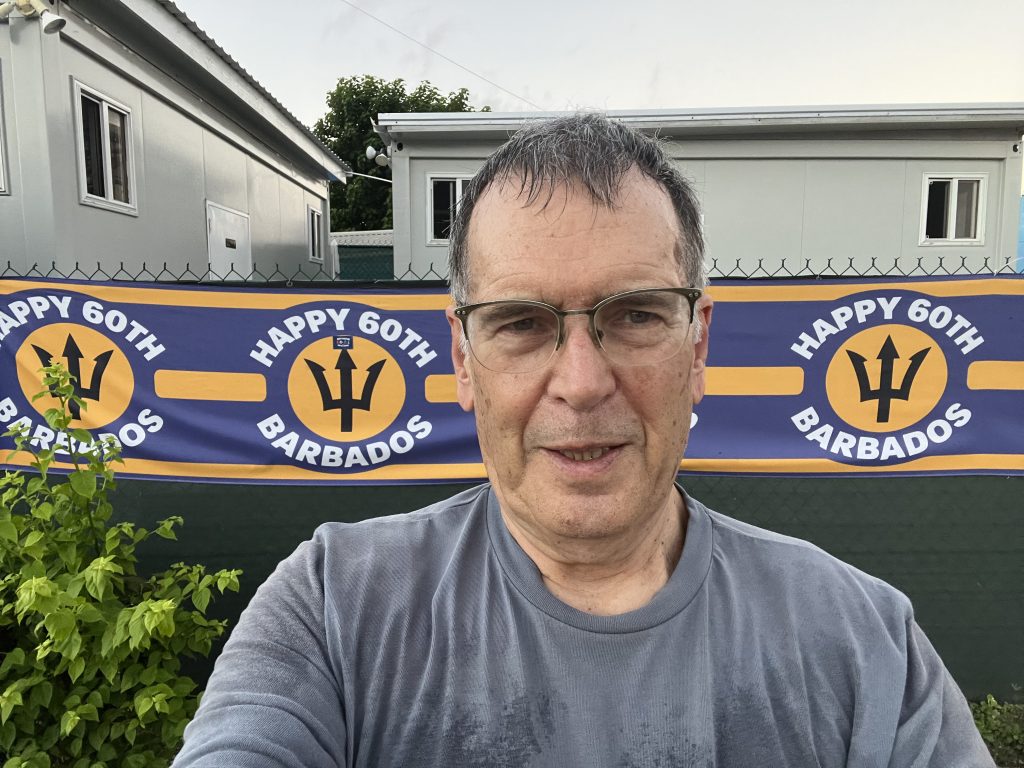
Anne and I have just spent a delightful fortnight in the Caribbean where once the British Monarch was sovereign. We were also in Barbados 6 years ago when the then Prince Charles saw a Republic proclaimed on the island and the ending of British sovereignty.
Sovereignty is a country’s independent power and supreme authority to govern itself without outside interference.
it is a topical subject. The world is in conflict over Russia’s challenge to Ukraine being a sovereign country, Israel challenging Palestinian and Iranian sovereignty and so on.
Last week leaders of the major sovereign states of China, Russia and the United States of America met together. There was also a meeting of our Prime Minister with European Union leaders that sought a partial reversing of Britain’s regained sovereignty following the referendum ten years ago.
On the Feast of Christ the King we celebrate another dimension of sovereignty which is not over lands and seas but over life and death.
Jesus Christ, today’s second reading announces, is gathering a kingdom to deliver to God ‘after destroying every rule and authority and power’. He is to be universal Sovereign ‘that God may be all in all’.
You and I as Christians have dual citizenship – of this country and another kingdom. As one of today’s prayers describes it, ‘a kingdom of truth and life, a kingdom of holiness and grace, a kingdom of justice, love and peace’ (Preface of Christ the King).
Both our citizenships bind us to other people, the one to citizens of the United Kingdom and the other to the Communion of Saints.
The ultimate scheme of things, as today’s Gospel indicates, involves choice not just of God but of God and people. Matthew 25 verses 31 to 46 indicates how godly choices end up in our taking full citizenship of the kingdom of God. ‘Then the king will say to those at his right hand, “Come, you that are blessed by my Father, inherit the kingdom prepared for you from the foundation of the world; for I was hungry and you gave me food, I was thirsty and you gave me something to drink, I was a stranger and you welcomed me, I was naked and you gave me clothing, I was sick and you took care of me, I was in prison and you visited me… I tell you, just as you did it to one of the least of these who are members of my family, you did it to me.’
Our Gospel reading portrays Christ as King in the context of the final judgement. As ultimate Sovereign he will possess authority to confer or deny heavenly citizenship on the basis of whether we have centred ourselves away from ourselves towards our neighbours, especially those in need.
How else will we fit in with the communion of saints without hearts that engage with and demonstrate self-sacrifice towards those around us, especially those in evident need?
On our holiday I spent time re-reading Donald Nicholl’s great book ‘Holiness’. Nicholls presents the self-surrender of Jesus in the Garden of Gethsemane as the clue to citizenship of the kingdom of heaven. I quote: ‘In his agony in the Garden, where he takes the place of all creation. ‘Let this cup pass from me,’ he says, ‘yet not as I will, but as you will. ‘The cup of which he was speaking was the cup into which the Holy Innocent One had drawn all the evils and poisons from all the world and which he was now being asked to drink to the dregs so that through him no drop of evil, whether from the past or the present or the future, should remain beyond redemption. Not a drop did he spill, either on his fellow men or upon mother earth… it has been made clear to us that the climax of the whole creation is self-sacrifice; that is the ultimate in reality; there is nothing beyond it; it is the end. There is the kingdom of heaven.
‘At the same time it appears that the capacity for self-sacrifice which the saints display only develops in those who have become spontaneous, pure and innocent through joyfully embracing suffering. Most of us, on the other hand, are still very much beginners; we find ourselves neither spontaneous nor pure nor innocent and we shrink from suffering. We feel to be far from the end, from the ultimate, far from the kingdom of heaven’.
Nicholls rejoices however that, though we might fear ending up among the goats rather than the sheep of today’s parable, we should not fear but take this comfort: the one person recorded in the Gospels as accepting the kingdom of heaven as a gift from Christ in his innocent suffering was, like Jesus, a condemned criminal nailed to a cross. I quote again ‘As he hung there, in his last agony, it was the good thief who proclaimed Jesus to be innocent when he said, ‘Lord, remember me when thou comest into Thy kingdom.’ The good thief had recognized that even though he himself did not possess… purity… Jesus was able to come into [his situation]… cleanse it and make it spotless for the final consummation. This he did, and that instantly… Jesus did not promise the good thief a place in the kingdom tomorrow, or at some future date, but ‘today’ – that is, now, instantly, without any preparation. Without any preparation the good thief, that total beginner, arrived at the end in an instant. ‘Lord, remember me when thou comest into Thy kingdom.’…’Today thou shalt be with me in Paradise.’
On this Feast of Christ the King we celebrate that sovereignty or kingly rule which is not over lands and seas but over life and death. This realm is ‘a kingdom of truth and life, a kingdom of holiness and grace, a kingdom of justice, love and peace’ and we enter it through repentance and putting faith in Jesus Christ as our Lord and Saviour.
You and I as Christians have dual citizenship of this country and that kingdom which is as near to us as God ‘in whom we live and move and have our being’ and whose mercy reaches to the sky.
‘We do not presume to come to this your Table trusting in our own righteousness but in your manifold and great mercies’.
‘Lord, remember me when you come into your kingdom.’…’Today you will be with me in Paradise.’
‘Now to him who is able to keep you from falling, and to make you stand without blemish in the presence of his glory with rejoicing, to the only God our Saviour, through Jesus Christ our Lord, be glory, majesty, power, and authority, before all time and now and forever. Amen. (Jude 24-25)