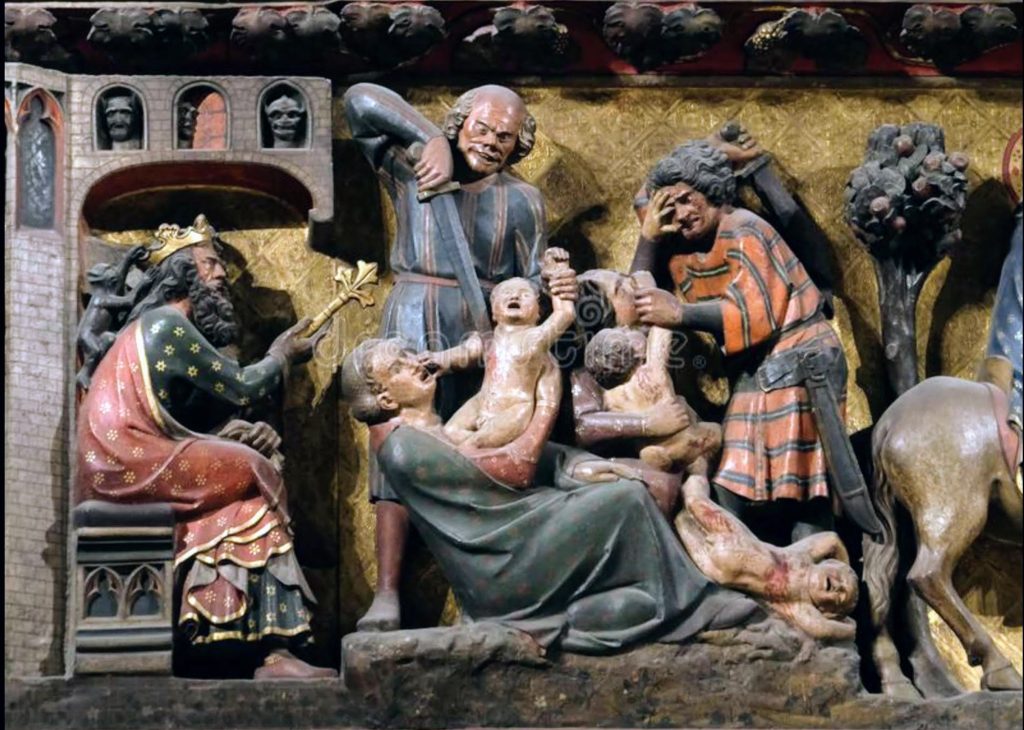
Tintoretto’s picture illustrates King Herod’s slaughter of the newly born after Christ’s birth used as the Gospel for today in some parishes brought me to mention in my sermon Christian concern for the unborn. I recall as a priest standing by families through difficulties in pregnancy. Having seen through my years how precious the life of the unborn are, 2025 has caused me distress. On Tuesday 17 June Parliament voted overwhelmingly to decriminalise abortion. The measure permits a woman to self-administer her own abortion up to birth without facing criminal sanction. This means that a life that is viable and would be protected from any abuse outside the womb can be ended by its mother inside the womb where, as an unborn baby it is now denied human rights. Of course there are situations when a woman has a terrible choice to make. What is astonishing is the rise in abortions since Lockdown in the UK to an estimated 300,000 in 2024 numbering a half of the 600,000 live births.
Introduction
A very happy Christmas to you all and many thanks for the Waitrose voucher from St Mary’s much appreciated by Anne and I.
We keep today the first Sunday after Christmas which has the same Gospel as Holy Innocents Day kept on the third day of Christmas.
Though the world clothes Christmas in tinsel, the Church’s liturgy and eight days of Christmas Octave go in another direction. There is no sentimentality in the day by day recalling of suffering – Stephen, Thomas Becket and today, very troublesome, the mindless slaughter of innocent children by King Herod in his attempt to eliminate the threat to his throne by the King of the Jews announced to him by the wise men.
Joy and sorrow are entwined in Christian faith. As we prepare to celebrate this Eucharist let us call to mind our failure to extend compassion to those who suffer as well as those times when our faith flags before the darkness and evil we see around us.
Sermon
What do we make of the sobbing and loud lament heard in Ramah recorded by Saint Matthew weeks after the birth of Our Lord? Besides its link with the slaughter of the innocent children by King Herod, Ramah has sorrowful association for the Jewish people. Jacob’s wife Rachel died there and in the sixth century before Christ Jews gathered there to set off to exile in Babylon after the Temple was destroyed. What do we make of ‘the Ramah’s’ set before us today in Ukraine, Somalia, Nigeria, the slaughter of young people on Bondi beach not to mention Gaza and the antisemitism it has sadly fuelled?
In his classic commentary on our second reading from Hebrews in King James’ version Bishop Westcott writes: ‘Time has not softened the sharpness of the impression which is made upon thoughtful spectators by the sight of the sorrows of life. Christ fulfilled man’s destiny, fellowship with God, by the way of sorrow; and the divine voice appeals to us to recognize the fitness of the road. [As Scripture says] ‘It became Him’ – most marvellous phrase – ‘It became Him for whom are all things, and through whom are all things, in bringing many sins unto glory to make the Author of their salvation perfect through sufferings’ (Hebrews 2:10).
Our Christian faith weaves together suffering and glory. It is convincing, because it opens us to the glory of the world to come whilst not devaluing suffering, as in today’s commemoration of the Innocents. It ‘became God – it was fitting for God’ to be born in poverty, suffer rejection and crucifixion so as to show the possibilities of human nature and Love’s triumph in the resurrection. Christ indeed fulfilled our destiny of eternal fellowship with God by the way of sorrow and invites us to see ‘the fitness of that road’. This road is the full context for the slaughter of the Innocents.
On this road, the road of Christian life, entering a new year for us on Thursday, we are blessed as believers to know the reality of what Isaiah prophesied at the end of our first reading, of how ‘God lifted [us] up and carried [us] in days of old’.
The parable of “Footprints in the Sand” is a popular Christian story where a person dreams of walking with God on a beach, seeing two sets of footprints, one theirs and one God’s, representing their life’s journey. During the hardest, saddest times, only one set appears, leading the person to question why God left. God replies that those were the times He lifted them up, explaining the single set of prints, emphasizing His constant presence and support during trials. Anne and I would certainly agree with that image of uplift travelling forward with the struggles and joys of Alzheimer’s. God lifts us up time and time again, not least through friends at St Mary’s, to make the impossible possible.
In older age we grow more aware of mortality, of friends pressing forward through sickness and disability, one of whose joyous funerals we attended last week. I have mentioned before in St Mary’s my concern about the Assisted Dying Bill about which I am in regular touch with my MP. On Holy Innocents Day, as we look back to our common origin in the womb, it is natural to mention another Christian concern about care for the unborn. I recall as a priest standing by families who have been similarly uplifted by God through difficulties in pregnancy. Having seen through my years how precious the life of the unborn are 2025 has caused me distress. On Tuesday 17 June Parliament voted overwhelmingly to decriminalise abortion. The measure permits a woman to self-administer her own abortion up to birth without facing criminal sanction. This means that a life that is viable and would be protected from any abuse outside the womb can be ended by its mother inside the womb where, as an unborn baby it is now denied human rights. Of course there are situations when a woman has a terrible choice to make. What is astonishing is the rise in abortions since Lockdown in the UK to an estimated 300,000 in 2024 numbering a half of the 600,000 live births. The Parliamentary legislation that allows abortion on demand was passed in the same week that the bill that would allow terminally ill patients predicted to have only six months to live to request medication so they can take their own lives. Anne and I have been members of CARE – Christian Action Research and Education – for many years. If you want to access or support this agency which works towards a culture and society reflecting a better story for everyone its website is care.org.uk
Our Christian faith weaves together suffering and glory. It rings true because the Christ Child suffered, died and rose again, opening to us the glory to come whilst not devaluing the suffering so many bear here and now. As the last verse of the second reading states: ‘Because Christ himself was tested by what he suffered, he is able to help those who are being tested’. May Our Lord be especially alongside the unborn and terminally ill. May The Holy Innocents slain by Herod whom we commemorate today, and who await fellowship with us beyond the grave, implore this grace of God for us and for UK Society: that we keep compassion for those who suffer, the unborn and the terminally ill, and that they and we keep an eye to the glory ahead that the Christmas Feast opens up to us.
Let’s have a moment of reflection enriched by a few verses from St Paul in his letter to Rome chapter 8 verses 16 to 21: ‘We are children of God, and if children, then heirs, heirs of God and joint heirs with Christ – if, in fact, we suffer with him so that we may also be glorified with him…. The sufferings of this present time are not worth comparing with the glory about to be revealed to us. For the creation waits with eager longing for the revealing of the children of God; for the creation was subjected to futility, not of its own will but by the will of the one who subjected it, in hope that the creation itself will be set free from its bondage to decay and will obtain the freedom of the glory of the children of God’.