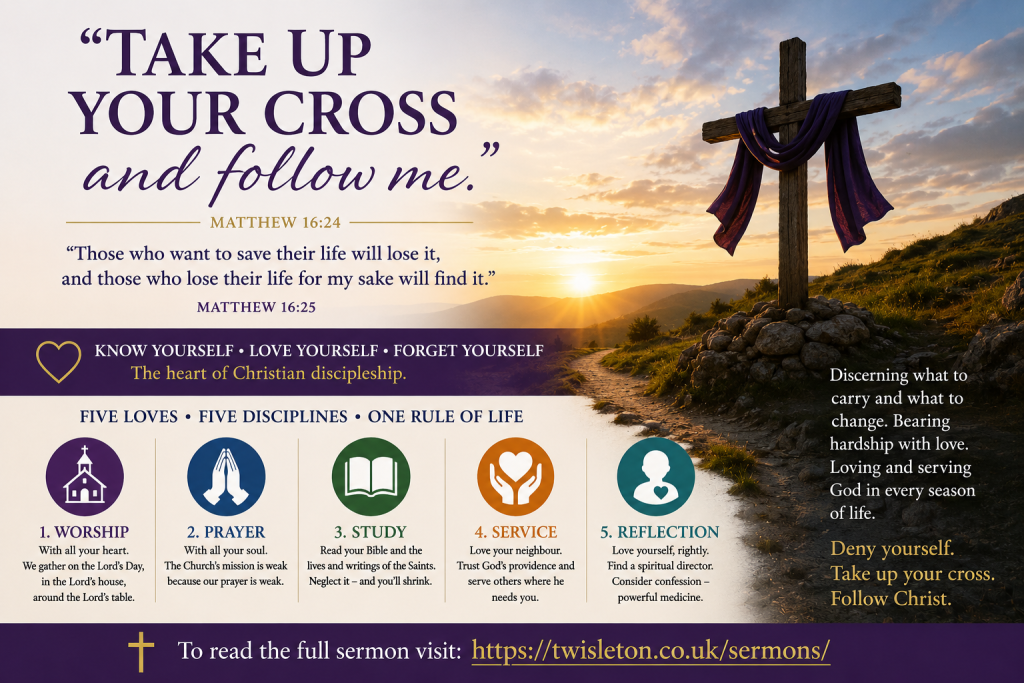
“Take up your cross and follow me.” Matthew 16:24 calls us beyond self-interest to active discipleship: discerning what to bear and what to change. We follow Christ through worship, prayer, study, service and reflection.
‘If any want to become my followers, let them deny themselves and take up their cross and follow me. ’ Matthew 16:24
What did Our Lord mean in saying this to Peter and the disciples and through today’s Gospel to each one of us as we practice Christian discipleship.
Well in verse 25 which follows Jesus gives part of the answer: ‘those who want to save their life will lose it, and those who lose their life for my sake will find it’.
Self loss for self gain- knowing ourselves, loving ourselves, forgetting ourselves is Christianity and though it traces back to the carrying of a Cross as part of Our Lord’s execution in the days of the Roman Empire which we would hardly take literally… except…
Didn’t Peter and Andrew die by crucifixion? They carried a cross. So did thousands of first, second and third century Christians before Emperor Constantine made Christianity the religion of the Roman Empire. And though persecuted Christians were not crucified in later centuries their following of Christ still led to their deaths as martyrs.
“Take up thy cross,” the Saviour said, “If thou wouldst my disciple be;deny thyself, the world forsake, and humbly follow after me.”
We are thinking of what Our Lord means in the invitation to take up our cross.
1500 years of Christianity pervade British culture so people use the cross carrying phrase for dealing with normal life annoyances like a hard job, a broken appliance, or a minor illness. It can be a statement of self-pity and the need to bear suffering passively.
In Matthew 16 Our Lord presents by contrast an active choice to love and serve God in contrast to a passive attitude of self-pity.
Discernment is a very important gift of reason and the Holy Spirit. There is a need to discern from among life challenges things we are to counter and things we are to bear humbly in love as a witness to Christ who bore and still bears our sufferings.
Some of us live in families with illness. We pray for healing of the illness but alongside our prayer is the readiness to seek medical attention and be Christ-like in our care for the sick.
The first paragraph of today’s second reading, Romans Chapter 12:9-13 makes this clear:
‘Let love be genuine; hate what is evil, hold fast to what is good; love one another with mutual affection; outdo one another in showing honour. Do not lag in zeal, be ardent in spirit, serve the Lord. Rejoice in hope, be patient in suffering, persevere in prayer. Contribute to the needs of the saints; extend hospitality to strangers’.
In London last week I took a fresh note of Blessed Edith Cavell’s statue off Trafalgar Square. I remember my mother showing it me 70 years ago and telling me the story of how Nurse Cavell took up her Cross treating wounded soldiers from both sides without discrimination during the First World War. Her Cross was a firing squad after being sentenced to death under German military law. We keep her feast every 12 October. Blessed Edith Cavell showed care out of a Christian ethic and paid the price.
What did Our Lord mean in saying ‘take up your Cross and follow me’?
Being ready to lay down your life with Peter and thousands down the ages like Edith Cavell.
Discerning creative acceptance of hardship as a Cross to be carried by individuals or in a family.
Taking up your Cross is also a description of ordination to the priesthood. There may be some in our congregation who are sensing heart tugs from Our Lord as he seeks to draw them into the sacred ministry. For myself I cannot think of a greater privilege in life, even if being a priest is more and more countercultural. When I was ordained priest 49 years ago people lifted their hats to me respecting my office. Today, shall I say, it’s a bit different – a joy but more of a Cross…
‘Those who want to save their life will lose it, and those who lose their life for my sake will find it’.
As Christians lay or ordained we respond to almighty and everlasting love by accepting the weight of Christ’s Cross in our discipleship. Experiencing God’s love is linked from our side to five loves, five disciplines linked to a rule of life involving worship, prayer, study, service and reflection.
First love — Worship. With all your heart. We gather on the Lord’s Day, in the Lord’s house, around the Lord’s table.
Second love — Prayer. With all your soul. The Church’s mission is weak because our prayer is weak. Shrug off the Cross of disciplined prayer and you’re little use as a Christian.
Third love — Study. Read your Bible and the lives and writings of the Saints! As the chorus runs: ‘Read your Bible, pray every day, and you’ll grow, grow, grow’. Neglect it — and you’ll shrink.
Fourth love — Service. Love your neighbour. Know your need of God, offer him your plans, and trust his providence to do the rest and make you effective in serving others where he needs you.
Fifth love — Reflection. Love yourself, rightly understood. Find a spiritual director — someone to talk to about your prayer. Consider confession — naming sins aloud is powerful medicine.
Our Lord says to each one of us this morning: ‘If any want to become my followers, let them deny themselves and take up their cross and follow me. Those who want to save their life will lose it, and those who lose their life for my sake will find it’.
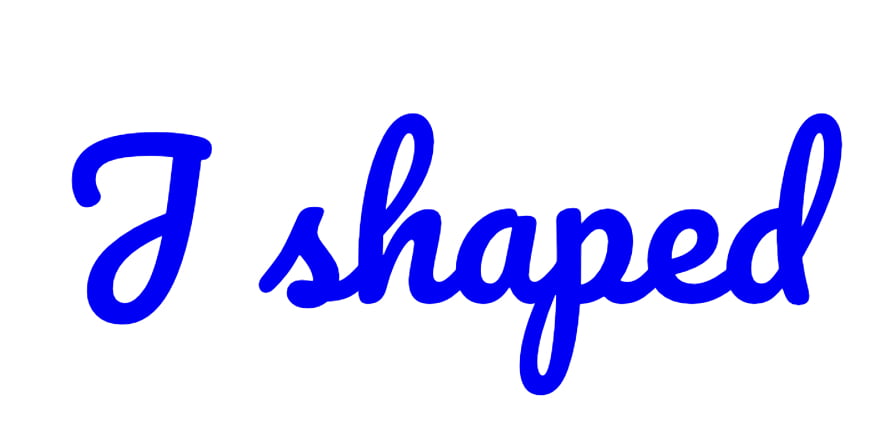
Take up your Cross, brothers and sisters, if not through martyrdom through carrying hardship, if not through getting ordained through more costly discipleship in worship, prayer, study, service and reflection. I end with the sign of the Cross I hope to live which is I crossed out… in the name of the Father, and of the Son and of the Holy Spirit. Amen