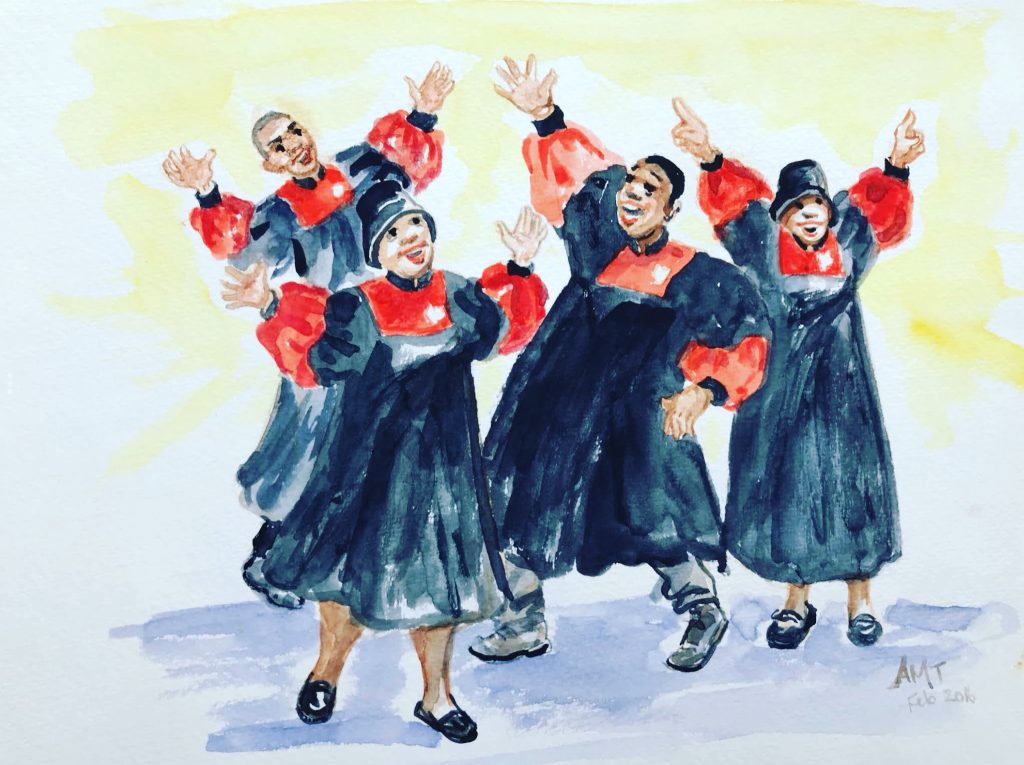
I can still see Fr David Charles every third Sunday when I cover passing in front of the altar at the end of a procession of up to twenty young people heading for children’s church. God, as the book of Wisdom says today is sovereign and governs all things ‘with great forbearance’ acting as he chooses. He chose to take Father David to himself. As today’s gospel of the wheat and weeds indicates God is our forbearing parent who’s infinitely patient and takes the long term view knowing the end day is coming. On that day we’ll see divine sense in our struggles over the death of our parish priest in the prime of life. Picture of parish clergy with Bishop Nicholas Reade at the patronal festival last year.
‘Although you, Lord, are sovereign in strength, you judge with mildness, and with great forbearance you govern us, for you have power to act whenever you choose.’ Wisdom 12:18
Those words at the heart of the passage we heard from the book of Wisdom were chosen for the first reading as they summarise the Gospel from Matthew 13 and the second part of the epistle from Romans 8. The parable of the wheat and the weeds is a reminder that the world we inhabit has good and bad in it which God has allowed but that good will triumph in the end. God like any good parent has forbearance. He’s patient with us, taking a long term view, knowing that harvest day is coming. On that day of judgement he will see a good harvest from the moral struggles of his children. The weeds, the bad they’ve lived alongside, will finally be discarded. To let us off trials and temptations in the here and now would make us lesser people in the hereafter.
With Fr David Charles’s funeral set for Tuesday, and bearing the loss everyone feels, I am struggling to make sense of his premature death and the loss of a great pastor and teacher of the Faith who so filled the emptiness we felt over a long pastoral vacancy. When Colin emailed me three Thursday’s back that Father David was in intensive care I heaved prayers to God. When his next email arrived on the Friday morning I felt sorely bereaved and disappointed by God whom I had trusted to point the medics to a diagnosis and healing. Now I am before you seeking another diagnosis and healing which is of us, the confused Christian community he served, healed and built up over his time as parish priest. I can still see him every third Sunday – up to today – passing with Deacon Stephen in front of the altar at the end of a procession of up to twenty young people.
God though, as the book of Wisdom says, is sovereign in strength and governs all things ‘with great forbearance’ having power to act as he chooses. He chose as sovereign Lord to take Father David to himself. This looks wrong to us but is righted as we ponder God’s forbearance and seek some of that for ourselves as we grapple to understand his passing and welcome healing in the face of it. As today’s gospel of the wheat and weeds indicates God is our loving parent who’s infinitely patient with us, forbearing, taking the long term view knowing that the end day is coming. On that day we’ll see that the struggles we are enduring have been infinitely worthwhile.
We struggle with forbearance day by day, bearing mortality, sickness, relationship problems and many of us affordability. We have to bear with extreme weather indicating a wider ecological crisis. How well the second half of our second reading from Romans 8:18-23, thrilling with the truth of the resurrection, gives voice to these struggles:
‘I consider that the sufferings of this present time are not worth comparing with the glory about to be revealed to us. For the creation waits with eager longing for the revealing of the children of God; for the creation was subjected to futility, not of its own will but by the will of the one who subjected it, in hope that the creation itself will be set free from its bondage to decay and will obtain the freedom of the glory of the children of God. We know that the whole creation has been groaning in labour pains until now; and not only the creation, but we ourselves, who have the first fruits of the Spirit, groan inwardly while we wait for adoption, the redemption of our bodies. For in hope we were saved. Now hope that is seen is not hope. For who hopes for what is seen? But if we hope for what we do not see, we wait for it with patience’.
As I read those words preparing this sermon I saw the groaning in spirit I have on account of Fr David’s premature death as part of a bigger picture, the groaning of all creation to be free from its bondage to decay and the yearning of the Christian community to enter fully ‘the freedom of the glory of the children of God’.
We ‘who have the first fruits of the Spirit, groan inwardly while we wait for adoption, the redemption of our bodies’ and this inward groaning has reason and purpose. I see the grief we feel at Fr David’s passing as a grief that is one with God who ‘judges with mildness and with great forbearance’. I would rather feel the confusion I feel in a cause, the Christian cause, that I know will ultimately succeed than feel good in another cause – be that materialism, secularism or atheism – that will ultimately fail. As we shall read in next Sunday’s section of Romans ‘we know – I know – that all things work together for good for those who love God’. Do pick up your bibles if you have time this week and read through the whole of Romans Chapter 8 which must be the most cheering passage in the Bible.
The death of a parish priest, one who loved us and still loves us, whom we ourselves love yet see no longer, is something like the weeds in the field of life which will in the end be discarded. This morning we express love for God in our worship and ‘we know that all things work together for good for those who love God’. May that be so for Fr David’s family and friends and for all of us privileged to know him.
Dead or alive we belong to the same family – so we pray for each other. Though Fr David doesn’t walk anymore in the third Sunday procession of young people he walks with us this morning on another shore and in a greater light which surrounds us at every Eucharist.
This worship of angels and saints that our worship is part of is no better described than by a pilgrim who years back attended the Divine Liturgy in the icon filled Cathedral of Kiev in the Ukraine which is itself today suffering grief, as we grieve, only of war dead. The pilgrim worshipper wrote up their experience in this eloquent passage:
‘There is always a crowd’, he said, ‘a promiscuity of rich and poor, of well dressed and tattered, a kaleidoscope mingling of people and colours – people standing and praying, people kneeling, people prostrated… There is no organ music, but an unearthly and spontaneous outburst of praise from the choir and the clergy and the people worshipping together…
‘And from the back and from the sides – and from the pillars and from the columns, look the pale faces of antiquity, the faces of the dead who are alive looking over the shoulders of the alive who have not yet died… All praising God, enfolding in a vast choric communion the few who in the Church have met on the common impulse to acknowledge the wonder and the splendour of the mystery of God.
‘You lose the sense of Ego, the separated individual, you are aware only of being part of a great unity praising God. You cease to be man and woman and become THE CHURCH (the Bride of Christ)’ And that is what we are this morning – the church, the community of Jesus – stretching beyond these four walls into eternity – living with lives that gain meaning from the conquest of death which brings and should bring our humanity into its right mind. Alleluia Christ is risen – he is risen indeed, alleluia!