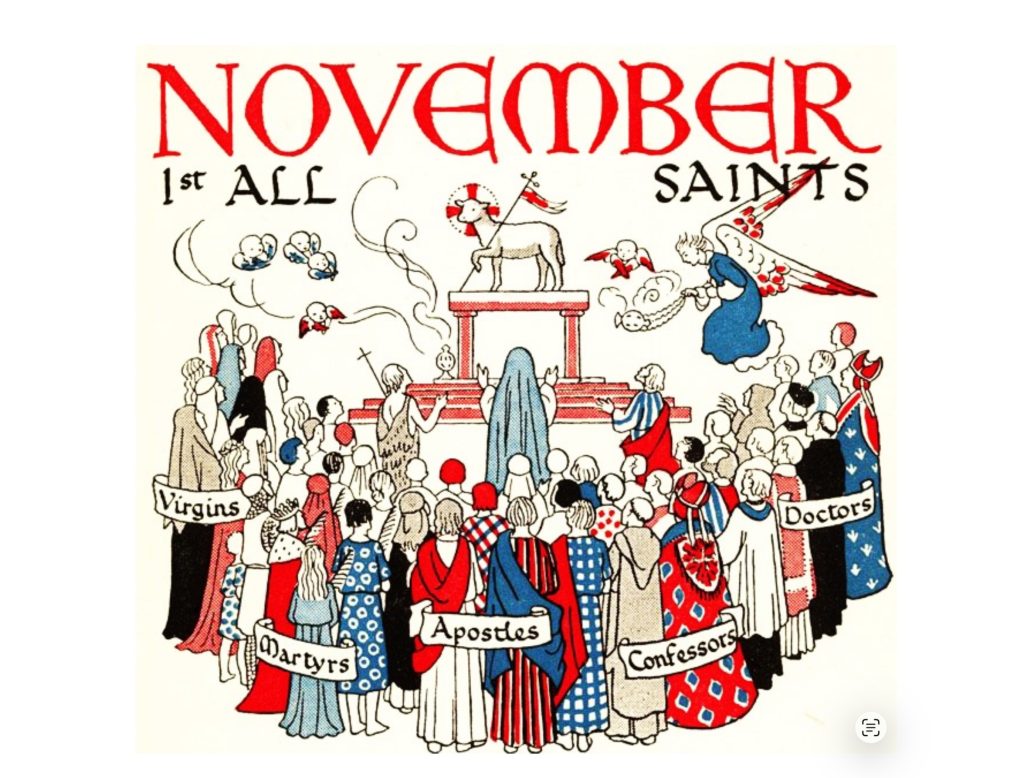
Christianity has a big aim and a tight focus. The aim is heaven: all people and things gathered together in Christ, sharing the glory of God. The focus is holiness: becoming saints ourselves and helping others become saints. The Beatitudes in Matthew 5 show us the way through humility, mercy, purity of heart and peacemaking. Léon Bloy wrote: ‘There is only one sadness, the sadness of not being a saint.’ All Saints Feast challenges us to be decisive in our choice of God so his light shines through us as we journey towards our heavenly homeland. Picture: Enid Chadwick.
Christianity has a big aim and a tight focus.
The aim is to see all people and all things gathered together in Christ in heaven.
The focus is on becoming saints ourselves and helping others to become saints.
Our first reading, from Revelation 7, sets before us the great destination of Christian life:
‘I looked, and there was a great multitude that no one could count, from every nation, from all tribes and peoples and languages, standing before the throne and before the Lamb, robed in white, with palm branches in their hands.’
Here is the communion of saints, gathered in worship before God.
Our second reading, from the First Letter of St John, promises that same glorious destiny:
‘Beloved, we are God’s children now… when he is revealed, we will be like him, for we will see him as he is.’
Then comes the tight focus: ‘All who have this hope in him purify themselves, just as he is pure.’
Our Gospel confirms it: ‘Blessed are the pure in heart, for they will see God.’
That promise stands at the heart of the Beatitudes, which open the Sermon on the Mount. The words Beatitudes and beatific share the Latin root beatus, meaning blessed. The Beatitudes describe the blessed ones, the saints, who will enjoy the beatific vision: seeing God face to face.
Who are these blessed ones? The poor in spirit, the meek, the merciful, the pure in heart, the peacemakers, those who mourn and those persecuted for righteousness.
Every one of these qualities is found perfectly in Jesus Christ. To become a saint is to become Christ-like.
All Saints Feast sets before us both our destination and the way towards it.
Christ’s resurrection reveals what matters most in life: what endures beyond death. Earthly life is a prologue. The book of life proper opens beyond the grave with Christianity’s Founder, who is the Way, the Truth and the Life.
Christians live knowing their true homeland is in heaven.
We come to church to develop a taste for that homeland. As the choir sings, ‘Taste and see that the Lord is good.’ In the sacred food of Christ’s Body and Blood, we anticipate the heavenly banquet of all the saints.
A fortnight ago I had the privilege of visiting the shrine of St John Mary Vianney, the Curé d’Ars, patron saint of parish priests.
In February 1818, the young priest was making his way to his new parish in the French countryside. Heavy mist obscured the landscape, and he lost his way. Meeting a young shepherd boy, he asked him to show him the road to Ars.
When the boy pointed out the way, Vianney replied with words that have echoed through two centuries:
‘You have shown me the way to Ars; I will show you the way to heaven.’
What a magnificent understanding of priesthood!
Priests are called to bring God to people and people to God. John Vianney had come not merely to administer a parish but to lead souls to heaven.
How much we priests need reminding of that supernatural calling!
There are vivid accounts of his preaching about heaven. On one occasion he became so overwhelmed by the prospect of seeing God that he cried out:
‘We shall see God! We shall see Him! Have you ever thought on that, my brethren? We shall see God! We shall see Him as He is, face to face!’
Those present said it seemed as though he could already see God and could not turn his gaze away.
What extraordinary conviction!
As a priest myself, I am conscious that people sometimes see our ministry as being rather like policemen on duty over morals, or as organisers of charitable service.
Both morality and service matter enormously. But for John Vianney, Christianity was something deeper and simpler: a yearning to see God, and to help others see him.
‘We shall see Him!’
St John Vianney is one of my patron saints. I invoke his prayers daily for my priestly ministry. Visiting his shrine as I approach the fiftieth anniversary of my priesting next year was especially moving.
He inspires me to persevere in becoming the saint God calls me to be.
And that brings us back to Christianity’s big aim and tight focus.
The aim is the communion of saints in heaven. The focus is on becoming saints ourselves and helping others towards that destiny.
We must beware of thinking of saints simply as Saints with a capital S — exceptional Christians whose holiness places them in a category entirely apart from us.
Today’s second reading challenges that notion:
‘Beloved, we are God’s children now… when he is revealed, we will be like him, for we will see him as he is.’
We are God’s children now!
Holiness is not an optional extra for unusually religious people. It is the calling of every baptised Christian.
Imagine your Christian life as something far greater than a struggle against sin.
You and I are called to become transparent to the glory of God, so that his light shines through us into places it has never reached before.
We are saints in the making.
That is why moral and spiritual purification matters. Sin obscures the light. It gets between us and the people God intends us to become.
Sin is not our deepest identity. Our deepest identity is found in Christ, who calls us to share his holiness.
Another French spiritual writer, Léon Bloy, expressed this with haunting simplicity:
‘There is only one sadness, the sadness of not being a saint.’
In his book Holiness, Donald Nicholl reflects on that sentence.
He observes how much of our lives we spend regretting failures: failing to become as famous, rich, beautiful or healthy as we once hoped. Such disappointments can trouble us for years.
Yet at the end of life, he suggests, we shall recognise that none of these failures is cause for ultimate sadness.
The only ultimate sadness is not to have become a saint.
What a searching thought for All Saints Day!
We spend so much energy pursuing things that will eventually pass away, while neglecting the one thing that lasts for ever.
The tragedy is not that we fail to become rich or successful. The tragedy is that we fail to become holy.
To reject holiness is ultimately to exclude ourselves from the communion of love for which God created us. That is the dreadful possibility we call hell.
But today’s feast is above all a celebration of hope.
The great multitude in Revelation is not a closed company. It is drawn from every nation, tribe, people and language. God’s invitation is wider than we can imagine.
And that invitation includes you and me.
All Saints calls us to wake up, to cast aside whatever dims God’s light within us, and to renew our determination to reach heaven together.
It calls us to become windows through which the glory of God can shine into our homes, our church and our world.
Christianity has a big aim and a tight focus.
The aim is heaven, where all things are gathered together in Christ.
The focus is holiness, becoming saints and helping others become saints.
Let us end with the Church’s own magnificent prayer from the Eucharistic liturgy:
‘There we hope to enjoy for ever the fullness of your glory, when you will wipe away every tear from our eyes. For seeing you, our God, as you are, we shall be like you for all the ages and praise you without end.’
Through Christ our Lord, to whom, in communion with all the saints, be glory, with the Father and the Holy Spirit, one God, for ever and ever.
Amen.