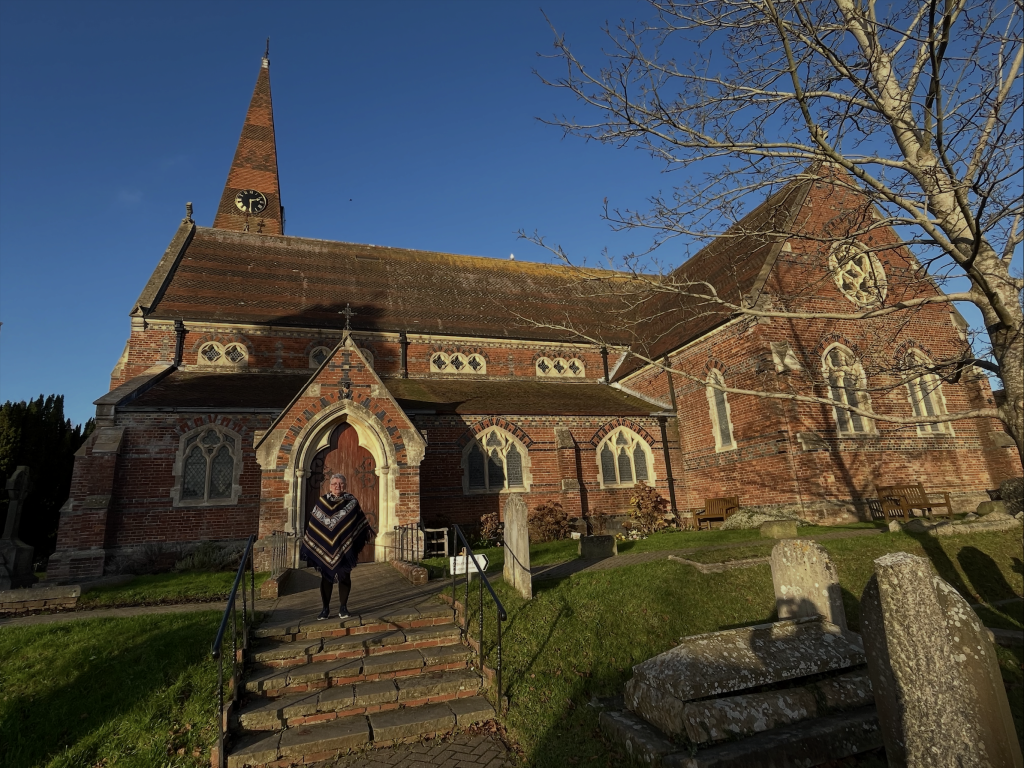
My sermon, preached today at St John the Evangelist, Burgess Hill, addresses how Christians can maintain confident faith when challenged. I argue that confidence in God complements rather than contradicts humility. Several grounds for confidence are identified: the historically attested resurrection of Christ; baptism, which unites believers with Christ’s death and resurrection; the inner witness of the Holy Spirit; Scripture; and regular Holy Communion. The Anglican three-legged stool of Scripture, tradition, and reason is also invoked. Karl Barth’s famous reply about whether he was sure about his faith was to quote the chorus: “Jesus loves me, this I know, because the Bible tells me so” — confidence can be simple yet profound.
More and more Christians are getting cornered. “How can you be so sure?” people ask. Too often we duck the question — out of inadequacy, or even a misplaced humility. But confidence in God is not the opposite of humility; it is its necessary complement.
This morning I want to explore the grounds of our confidence as Christian believers.
The three Sunday readings point us in the same direction. Genesis 21, as so often with the Old Testament reading, illuminates the Gospel — today a continuation of Matthew 10, Christ’s missionary charge to his apostles: costly, demanding witness. But it is the second reading that thrills with the confidence we need. Romans 6 is so charged with Easter certainty that it is the passage chosen to first announce the resurrection at the Easter Vigil itself — read aloud as the altar candles are lit from the Paschal Candle and the church blazes back into light. Christ being raised from the dead will never die again. That is where we begin.
1. The Resurrection
Every defence of Christianity begins here. Centuries of historical scrutiny have not weakened the claim: Jesus of Nazareth, crucified under Pontius Pilate, rose from the dead. The New Testament evidence demands a verdict. Anglican tradition speaks of a three-legged stool — Scripture, tradition, and reason — and all three legs rest on the same risen Lord Jesus Christ. If our faith feels shaky, one honest remedy is to return to the historical evidence, perhaps through a contemporary writer who has wrestled with it carefully.
2. Baptism
More personal than any argument is the sacrament that sealed our faith. Romans 6 speaks with extraordinary precision here. ‘We have been buried with him by baptism into death, so that, just as Christ was raised from the dead by the glory of the Father, so we too might walk in newness of life’. Notice the tenses. Our dying with Christ is past — done, settled, unrepeatable. We have been buried with him. The resurrection life is the present unfolding consequence — ‘we too might walk in newness of life’ — linked always to renewed moral obedience.
This is what the Easter Vigil enacts so powerfully. The moment the Paschal Candle is used to light the altar candles and Church floods with light marks the passage from darkness to light, death to life, bondage to freedom, the old age to the age to come. That transition happened first in Christ. It happened for us in our baptism. It is not a feeling or an aspiration — it is a fact.
Luther knew this. When temptation or doubt assailed him he would mutter to himself: ‘Baptisatus sum — I am baptised’. Not “I hope I am saved” or “I feel close to God today.” Simply: ‘I am baptised. That is enough’.
3. The Holy Spirit
Baptism commits us to Christ and fills us with the Holy Spirit — and we cannot do without him. As Paul writes in 1 Corinthians 12:3: no one can say “Jesus is Lord” except by the Holy Spirit. No one can hope to be a convinced or convincing Christian without this inner witness.
The Eastern Orthodox tradition identifies the Holy Spirit simply with Tradition itself — he alone hands on to each generation what Christ has done for the world. We encounter this reality most vividly in holy people — those whose lives make Jesus credible and attractive. And there are moments — a particular liturgy, a season, a course — when the Spirit may be freshly welcomed, and our confidence deepened as a result. These moments are worth seizing wholeheartedly.
4. Scripture
The Holy Spirit opens Scripture to us, and Scripture speaks back with authority. ‘All Scripture is breathed out by God and profitable for teaching, for reproof, for correction, and for training in righteousness, that the man of God may be competent, equipped for every good work’ (2 Timothy 3:16-17). A confident believer takes God at his word.
When people press us — “how can you be so sure?” — they are searching for the grounds of our security. We can do no less than give testimony to God’s faithfulness shown in Jesus. ‘It is God who establishes us in Christ… our sufficiency is from God’ (2 Corinthians 1:21, 3:5).
When the great theologian Karl Barth was asked how he could be so confident in his faith, he replied by quoting a children’s chorus: ‘Jesus loves me, this I know, because the Bible tells me so’. Confidence can be simple and profound at once. A practical implication follows: if our faith needs strengthening, regular Bible reading is one of the surest means — daily notes are readily available online for those who want a way in.
5. Holy Communion
What more powerful means is there of making Christ’s once-for-all gift a convincing day-to-day reality than receiving his body and blood? Truly, truly, I say to you, unless you eat the flesh of the Son of Man and drink his blood, you have no life in you (John 6:53). The Eucharist is not a memorial of something long past — it is the ongoing renewal of the gift of the Son.
When people ask me how sure I am of God, I like to turn the question around: however sure or unsure I may feel on a given day, I know his love — because 32 232. he once gave me his Son, and renews that gift at every Eucharist.
Conclusion
Resurrection. Baptism. The Holy Spirit. Scripture. Sacrament. These are not merely doctrines — they are invitations and gifts. But they yield their full power only as we make an ongoing, robust commitment to Christ.
Confidence and humility are not rivals. The most confident believing is twinned to the deepest sense of need. As we witness to God’s goodness in our own lives — his forgiveness, his healing, his deliverance flowing from the Cross — we find our own faith renewed in the telling. Seeking his grace always meets with a response. And that response builds confidence further still.
With Paul in Romans 1:16, we can then say without embarrassment: ‘I am not ashamed of the Gospel, for it is the power of God for salvation to everyone who believes’.