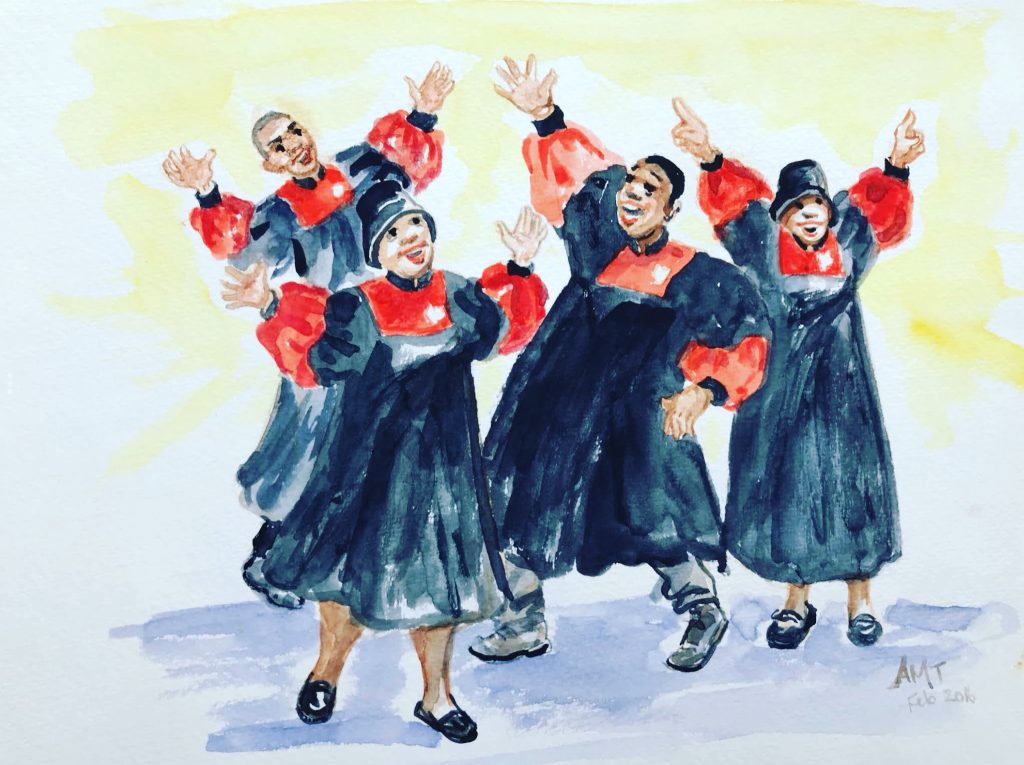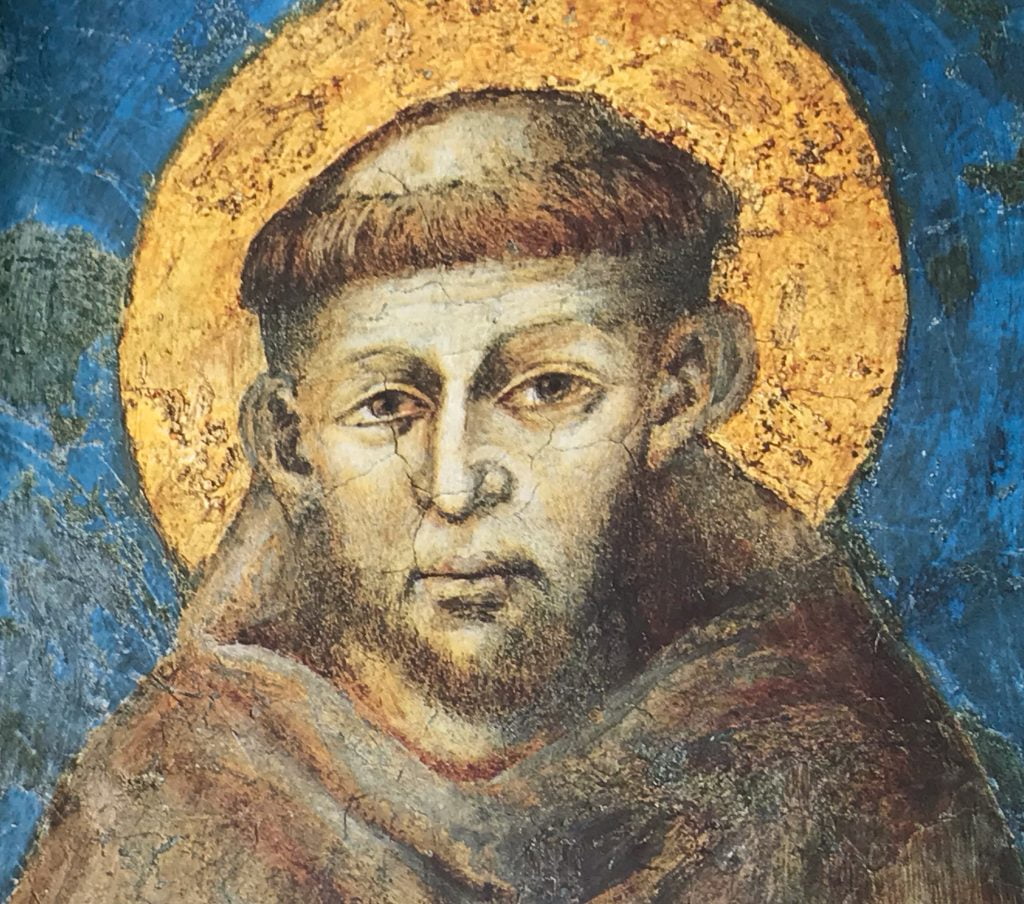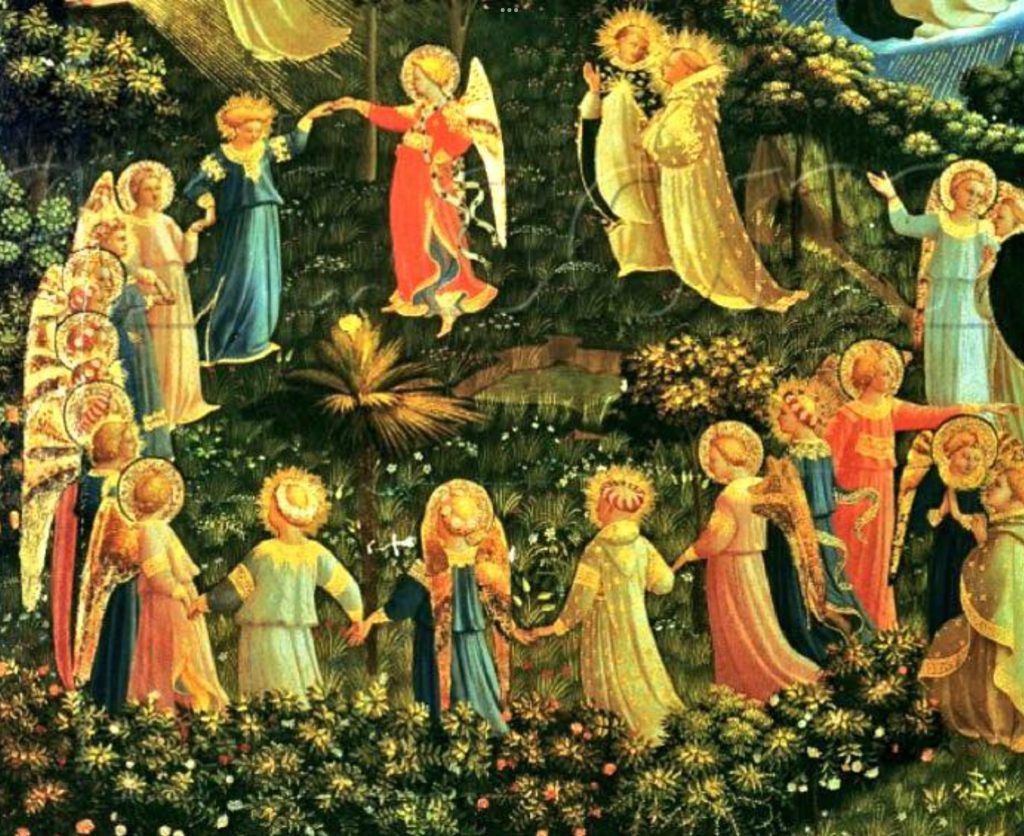
The Feast of All Saints sets our sights on inclusion in the proper Christian sense, what Chesterton called the democracy of the dead. To the eyes of the world, even parts of the Anglican world, inclusion is defined in this-worldly terms so much energy is put into sexual politics. To the eyes of Christians the astonishing and distinctive inclusion in membership is with those who lived and died in Christ and so live on, close to us, in the power of the resurrection.
‘I believe in the communion of saints… the resurrection of the body, and the life everlasting’.
The Feast of All Saints sets our sights on inclusion in the proper Christian sense, what Chesterton called the democracy of the dead. To the eyes of the world, even parts of the Anglican world, inclusion is defined in this-worldly terms so much energy is put into sexual politics. To the eyes of Christians the astonishing and distinctive inclusion in membership is with those who lived and died in Christ and so live on, close to us, in the power of the resurrection.
We come to Church on Sundays yes with an eye to the comfort of our earthly members – Anne and I are grateful for the welcome St David’s always provides, especially as we live with Alzheimer’s – but what is prime in this Church, is less access than awe, the sense of awe in its worship evoked by priest, choir and servers as they execute the age old liturgy we as Anglicans are stewards of.
Our liturgy builds around this day, Sunday, the Day of Resurrection and serves the gathering of the Lord’s people on the Lord’s Day in the Lord’s house around the Lord’s table. To believe in the communion of saints is something utterly practical, ‘joining [at the Eucharist Sunday by Sunday, day by day] with angels and archangels and with all the company of heaven, who forever sing to praise the glory of God… [celebrating] Jesus Christ… who rose victorious from the dead… to [whose] faithful people… life is changed, not ended with death [so that] when our mortal body lies in death, there is prepared for us a dwelling place eternal in heaven’.
The Collect for All Saints’ Day prays ‘Almighty God, you have knit together your elect in one communion and fellowship in the mystical body of yours Son Christ our Lord’ and it is as that body with its extensions in paradise, heaven yet militant here on earth that we gather in St David’s this morning.
May the Church always play to its distinctive, the distinctive belief in ‘the communion of saints… the resurrection of the body, and the life everlasting’.
Coming from England I bring greetings from Chichester and London Dioceses where I have permission to officiate alongside my Caribbean link here and as a Canon of St George’s Cathedral in Guyana. One of my three Bishops is moving in January to be Archbishop of Canterbury. God bless Sarah Mulally as she takes on an unenviable task especially as the ordination of women is not widely accepted by Anglicans, let alone the blessing of same sex unions. The Archbishop of Nigeria has already broken communion with her on both counts and there are a lot of Nigerian Anglicans. I am close to a Nigerian Bishop who has seen priests murdered and can only leave his compound driven by someone else with an eye to his safety. In Nigeria and many parts of the world being a Christian costs you, which may explain the strength of Christian allegiance there. Alas, changes in the Anglican Communion and its leadership have a cost on the ground there. It is getting as dangerous in parts of the world to be a Christian as it is to be part of the LGBT community. I wish it were not so – but that’s the way it is – which explains the rough waters we have ahead as Anglicans. Our belief in the communion of saints, in one holy, catholic and apostolic church is, as I am saying, heaven-oriented but it retains a ‘this worldly element’ so that what happens in Canterbury and Lagos impacts us in Barbados.
I’ve known Fr Noel and Hazel nearly 40 years going back to 1987 when I came to the West Indies to train Amerindian priests in Guyana’s interior. Anne and I were married there in 1988. Over my years running the Alan Knight Training Centre I became very aware of another aspect of the communion of saints. The north Rupununi was Anglican and the south Rupununi was Roman Catholic. I had to explain to my ordinands why the action of an English King 500 years ago meant Christians in the Caribbean were no longer in full communion. How lovely to see King Henry VIII’s descendent King Charles III praying with the Pope in the Sistine Chapel last week. We are moving closer as denominations in some ways but, as I said earlier, the appointment of Sarah Mulally will have its repercussions ecumenically with Rome and the Orthodox who see the communion of the Church as inseparable from full communion of its Bishops. In the Church of England that communion is impaired. I am licensed by Bishop Sarah but her oversight of me as a priest of The Society is exercised by Bishop Jonathan of Fulham. Sarah will serve the unity of the southern province of the Church of England by ministering in a similar way to the London plan using provincial visitors. It’s a very English live-and-let-live amicable disagreement model but its sadly untypical of many parts of the world.
Since my last visit I’ve been working with Premier Christian Radio on an unfashionable doctrine linked to today’s Feast, namely The Second Coming of Christ with a booklet – copy here for Fr Noel show – a radio series and an article for the magazine of the Community of the Resurrection at Mirfield who once served Codrington College. It is an attempt to make an awesome truth accessible. I’ll end by reading a section of the book which centres, as I’ve already done this morning, on the primacy of the resurrection as the distinctive truth of Christianity:
‘Although the tendency of living forms is towards the greater chaos of death and dissolution, the emergence at two points in time and space of God in the flesh of Jesus is in harmony with our understanding of the theory of chaos and human existence. The emergence of God at two points – the incarnation and second coming – to show us his face is in harmony with scientific truth as much as the emergence of beautiful rainbows on stormy days.
‘God’s plan seeks the cohesion of all things to be fully revealed at the Second Coming of Christ gathering ‘the communion of saints’. It is the work of the Holy Spirit down through history.
Understanding the hope of Christ’s Return is inseparable from pondering New Testament faith in his Resurrection which contains joy linked to an expectation that the fulfilment of world history is close at hand. The gathering and perfection of God’s never-ending family is a process being completed. The prayer of the Church is ‘Maranatha, come, Lord Jesus’ looking to a perfection suited to that Coming and the Church being fitted to become the Bride of Christ. Christ’s Coming is the hope of the Church in its visible disunion. Though believers in Christ have spiritual unity across denominations their incapacity to worship fully together is a clear blemish many would seek to address. Roman Catholic, Orthodox, Anglican, Methodist, Lutheran, Pentecostal – so many churches existing with impaired fellowship and even different dates for Easter. Yearning for the Second Coming of Christ seems inseparable from deeper yearning for perfecting the visible unity of Christians so words about Holy Communion in the New Testament come true in practice: ‘The bread that we break, is it not a sharing in the body of Christ? Because there is one bread, we who are many are one body, for we all partake of the one bread’ (1 Corinthians 10:16-17).
Lord have mercy – Saints of God pray for us – so Christians on earth finally share one bread and that ‘we may come to those ineffable joys you have prepared for those who truly love you’ the communion of saints… the resurrection of the body, and the life everlasting. Amen.