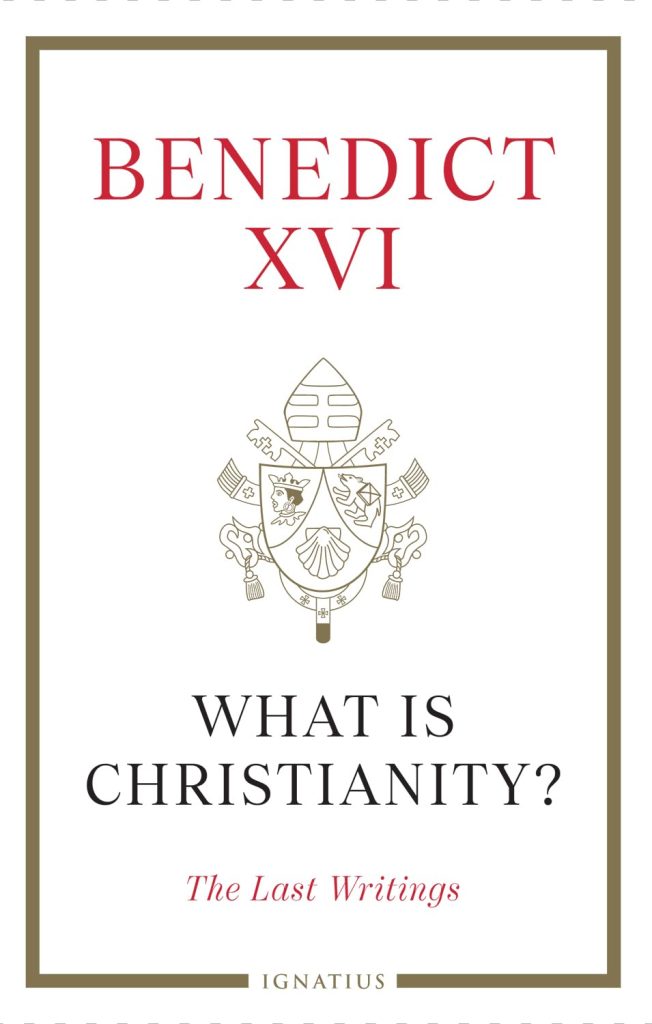
In this book the late Benedict XVI summarises the missionary heart of Christianity which lies in encountering the truth, love and joy of Jesus Christ. ‘What Is Christianity?’ addresses the heart of Christianity, its relationship with other religions, spirituality, liturgy, celibacy and the tragedy of abuse alongside many other contemporary issues. The book is challenging and affirming as again and again it comes back to the transformative good news and the need to keep this, the main thing as the main thing in mission, dialogue, worship and prayer. ‘God became man for us. Man, his creature, is so close to his heart that he united himself with him, concretely entering history. He speaks with us, lives with us, suffers with us, and took death upon himself for us’.
Benedict XVI What is Christianity?
The last writings Edited by Elio Guerrero & Georg Gänswein
Ignatius Press 2023 Kindle £14.52 ISBN-13 978-1642292848 216pp printed
‘Let us proclaim Jesus Christ, not in order to gain as many members as possible for our community, much less for the sake of power. Let us speak about him because we feel that we must hand on this joy that was given to us. We will be credible announcers of Jesus Christ when we have truly encountered him in the depths of our being, when, through the encounter with him, we have received the gift of the great experience of truth, love, and joy’.
In this succinct paragraph the late Benedict XVI summarises the missionary heart of Christianity which lies in encountering the truth, love and joy of Jesus Christ. After resigning from the papacy in 2013 he continued writing but out of respect for Pope Francis asked that these writings should be published only after his death which occurred in 2022. ‘What Is Christianity?’ addresses the heart of Christianity, its relationship with other religions, spirituality, liturgy, celibacy and the tragedy of abuse alongside many other contemporary issues. The book summary notes how ‘with prophetic insight into our times, Benedict warns of a “radical manipulation of man” in the name of tolerance, insisting that the only “authentic counterweight to every form of intolerance” is Christ himself – and Christ crucified’.
I found this short book inspiring as it captures succinctly the dynamic of Christianity today which is found sadly away from Europe. ‘Some branches of the large tree that grew from the mustard seed of the Gospel have become dry and fallen to the ground, new life springs from the encounter of the expectant religions with Christ. Where there was only weariness before, new dimensions of the faith are manifested and bring joy’. I was brought up short by a warning refrain about spirituality and truth. Karl Rahner wrote ‘The Christian of tomorrow will be a mystic, or else he will no longer exist’ which has inspired many of us in mission towards spiritual ecumenism and dialogue with other Faiths. No, Benedict counters Rahner, mysticism apart, ‘for a Christian, the God who in Jesus Christ binds himself heart and hand to us men and who endured being human for us and among us even unto death and beyond death, is the center of Christianity’. Knowing Jesus brings spiritual depth but it is the depth of the Holy Spirit sent by God. Another wake up call for me, as one partially persuaded by Rahner’s optimistic concept of ‘anonymous Christians’, came in Benedict’s forceful onslaught on that idea:
‘Karl Rahner’s well-known thesis of anonymous Christians. He maintains that the basic and essential act at the root of Christian existence, which is decisive for salvation, in the transcendental structure of our consciousness, consists in the opening to the Other, to unity with God. In this vision, the Christian faith would raise to consciousness what is structural in man as such. Thus, when a man accepts himself in his essential being, he fulfills the essence of being a Christian without knowing what it is in a conceptual way. The Christian, therefore, coincides with the human, and, in this sense, every man who accepts himself is a Christian even if he does not know it… this theory is fascinating but it reduces Christianity itself to a purely conscious presentation of what man is in himself and therefore overlooks the drama of change and renewal that is central to Christianity’.
Another component of ‘The last writings’ concerns the primacy of worship and how ‘the misunderstanding of the liturgical reform that spread widely in the Catholic Church led to an increasing prominence of the aspect of instruction and of one’s own activity and creativity. The doings of men almost made us forget the presence of God’. On priestly celibacy, in writings that were leaked one imagines to the discomfort of his successor: ‘the functional sexual abstinence was transformed automatically into an ontological abstinence. In this way, its motivation and its meaning were changed from within and profoundly’. The tragedy of clerical abuse of minors is touched upon linked in his thought to the student revolution that made his thinking more hesitant on change in the church: ‘It must be mentioned that among the features of the Revolution of 1968 was the fact that even pedophilia was proclaimed as permissible and appropriate. For the young people in the Church, at least, but not only for them, this was in many ways a very difficult time’. On the forsaking by Roman Catholic ethicists of natural law: ‘In the council’s struggle for a new understanding of revelation, the natural law option was almost completely set aside, and a moral theology based entirely on the Bible was demanded.. the thesis that morality should be defined exclusively on the basis of the purposes of human action was widely accepted. The old adage “the end justifies the means” was not confirmed in quite so crude a form, and yet the concept contained in it had become decisive. Consequently, there could no longer be anything absolutely good, much less anything categorically evil, but only relative value judgments. There was no longer the good, but only what was relatively better at the moment and depending on the circumstances’.
‘What is Christianity?’ is challenging and affirming as again and again it comes back to the transformative good news and the need to keep this, the main thing as the main thing in mission, dialogue, worship and prayer. ‘God became man for us. Man, his creature, is so close to his heart that he united himself with him, concretely entering history. He speaks with us, lives with us, suffers with us, and took death upon himself for us’. Pope Benedict XVI’s extraordinary life and teaching was centered on this determination to accept subjectively as his own the objective core of the Christian faith – salvation – and encourage others to accept Jesus and be made Christ’s co-worker in worship and service. Canon Dr John Twisleton