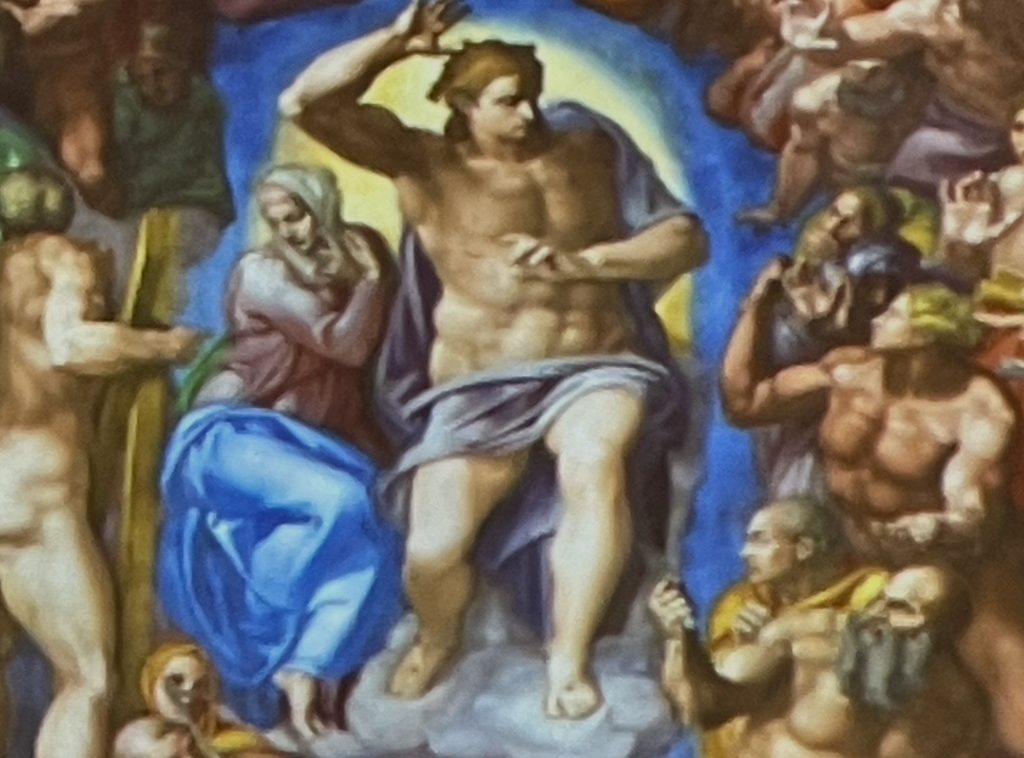
We come from God. We belong to God. We go to God. God does not simply wait at the end of our journey. He comes to meet us. This is the movement to come captured by Michelangelo in the Sistine Chapel on which we stake our lives: ‘He will come again in glory to judge the living and the dead and his kingdom will have no end’ – even so, come, Lord Jesus!
A sermon, especially one from an overseas visitor, is an opportunity to stand back from what we are about and set it in a wider context as the preacher opens up the scriptures for us.
I bring greetings from the Church of England and the Diocese of Chichester along with that of Anne and my host Bishop Wilfred Wood, Sir Wilfred as you might know him.
It is always a joy to be at the altar with my friend Fr Noel, invited to speak into the awesome liturgy we are privileged to celebrate at St David’s which serves a fresh offering of our souls and bodies as a living sacrifice in union with Our Lord in the Holy Eucharist.
Standing back from what we are about I feel honoured to remind you that this celebration in St David’s Church traces back four centuries to a wave of Christian mission flowing from England.
The recent visit of King Charles to the Caribbean has been a reminder of that missionary wave as well as of its less noble aspects. God writes straight through crooked lines!
The standing back we are about on the second Sunday before Advent might include the approaching season or indeed the church’s seasons as a whole.
You and I move through time. We come from God. We belong to God. We go to God.
You and I also move through the Church’s seasons – Advent, Christmas, Lent and Easter – which have a formative role in our lives. We see the approaching season of Advent as the first season of the Church’s Year but actually it is the last. As Lent appeared to prepare for the Easter Feast Advent came about to prepare for Christmas but they added a brief addressing of the completion of Christ’s work at his Return.
The Church’s Year reminds us of the work of Our Blessed Lord Jesus Christ, his coming, teaching, suffering, death, resurrection, ascension and gift of the Spirit at Pentecost. That work of Our Lord remains incomplete until the day of his Return. As we affirm at the centre of the liturgy: Christ has died, Christ is risen, Christ will come again!
In the last weeks of ordinary time and first weeks of Advent we stand back to put the end in view.
Steven Covey’s Seven Habits of Highly Effective People contains the habit ‘Always keep the end in view’. To be effective in life we need to keep the end in view and avoid getting so immersed in day to day stuff that we lose our sense of direction.
To be effective in Christian life we need Advent to help us keep our end in view.
In today’s Gospel from Matthew 25 Our Lord uses the parable of wise and foolish bridesmaids as a reminder to continually keep that end in mind. The wise bridesmaids prepared their lamps so they could greet the bridegroom. The foolish ones were unprepared. The parable is a call to watchfulness with regard to our acting out our faith. It also has a link with the wider New Testament image of the return of the Lord.
Christ’s return is central to hope for the world out of which he calls forth people of faith into his Church which is central to history as we read in Ephesians 5:25-27: ‘Christ loved the church and gave himself up for her, in order to make her holy by cleansing her with the washing of water by the word, so as to present the church to himself in splendour, without a spot or wrinkle or anything of the kind’. The whole history of the cosmos, no less, serves to prepare his perfected Bride, the Church for the arrival of Christ her heavenly Bridegroom. Believers are being prepared to be one with the Bride as they follow the Church’s Year, through their worship, prayer, study, service, reflection and by living positively through pain and sorrow. In these ways their character is formed, a character transparent to ‘the light of the knowledge of the glory of God in the face of Jesus Christ’ (2 Corinthians 4:6).
The standing back this morning’s scripture primarily invites is the standing back from our selves.
Known as watchfulness it is a discipline commended by the Church, for example as part of night prayer when we look back upon the joys and sorrows of the day with thanksgiving and penitence – that is sorrow for sin. ‘Keep awake therefore, for you know neither the day nor the hour’ in the call to watchfulness at the end of the Gospel..
Our second reading from 1 Thessalonians 4:13-18 needs a little explanation. It is one of the earliest texts in the New Testament. Twenty years after the Resurrection the belief that Our Lord was due to return at any hour was very strong and the Thessalonian Christians were concerned about those who were dying among them that they had missed out. Paul urges them not to grieve ‘for since we believe that Jesus died and rose again, even so, through Jesus, God will bring with him those who have died’. He seeks to prove this from a ‘word of the Lord’. Scholars divide on whether this means a saying of the earthly Jesus from the Gospels or of the risen Christ through a Church prophet like St John the Divine in the book of Revelation. It is a vivid image which needs adjusting to today’s cosmology: ‘the Lord himself, with a cry of command, with the archangel’s call and with the sound of God’s trumpet, will descend from heaven, and the dead in Christ will rise first. Then we who are alive, who are left, will be caught up in the clouds together with them to meet the Lord in the air; and so we will be with the Lord forever’.
God does not simply wait at the end of our journey. He comes to meet us.
You and I move through time including the Church’s seasons. We come from God. We belong to God. We go to God.
Yet there is another movement central to our Christianity – the movement of God to us.
The preacher is a reminder of that movement, relaying God’s word to us all.
The altar with its Tabernacle and ever burning light is another reminder of God’s movement towards us as we partake of the Blessed Sacrament consecrated by our priests.
There is a movement towards us at any time or place which is the Holy Spirit, oil in our lamps, who keeps alive in us a longing for Christ’s coming and the joy of heaven.
Then there is that movement to come on which we stake our lives: ‘He will come again in glory to judge the living and the dead and his kingdom will have no end’ – and with the whole Church, his beloved Bride, we pray: even so, come, Lord Jesus! Amen.