God forgives us, so we forgive. God shows us mercy, so we show mercy. Forgiveness is lovely until we have someone to forgive! Repeating the Jesus Prayer can help us become conduits of God’s compassion.
God forgives us, we need to forgive – God shows us mercy, we need to show mercy to others.
As this week’s Gospel follows on from last week’s section of Matthew Chapter 18 my sermon follows on from Fr David’s with his image of carrying a large sack filled with sand, with a hole in it, and sand is spilling out behind you. Our sins are running out behind us, and we do not see them. Yet we judge the sins of others. To quote our parish priest, courtesy The Link – thankyou, Louise – ‘We are very good at seeing the faults of other people and remarkably poor at seeing our own. The Gospel calls us to something better. We are called to be people who can both receive correction and, when necessary, offer it; people who can speak the truth without cruelty; people who can forgive without pretending that wrong does not matter’.
St Richard’s is vitalised by such folk. They keep our community fresh by their practical Christianity. Forgiveness is a lovely idea until you have someone to forgive. Commenting on today’s Gospel C.S.Lewis explained ‘we forgive, we mortify our resentment; a week later some chain of thought carries us back to the original offence and we discover the old resentment blazing away as if nothing had been done about it at all. We need to forgive our brother seventy times seven not only for 490 offences but for one offence.’ I am a slow learner here.
Forgiveness is an attitude which the servant in the Gospel exploited whilst his fellow servants admired it and brought him to justice.
On Wednesday at Mass I noted the countercultural nature of our Christian Faith. The first reading that day was about not bothering to get married as the Lord is coming back and the Gospel announced a blessing on poverty. I said we go to Sainsbury’s to get what we want but come to St Richard’s to get what we need. Sometimes we need shock-treatment and we can rely on scripture for this, especially the teaching of Our Blessed Lord. I like to be liked so I found the last verse of Wednesday’s Gospel – Luke 6:26 – alarming: ‘Woe to you, when all people speak well of you, for so their fathers did to the false prophets’. Similarly the last verses of today’s Gospel might alarm any one of us who are reluctant to forgive other people when they hurt us.
‘I forgave you all that debt because you pleaded with me. And should not you have had mercy on your fellow servant, as I had mercy on you? And in anger his master delivered him to the jailers, until he should pay all his debt. So also my heavenly Father will do to every one of you, if you do not forgive your brother from your heart’ Matthew 18:32-35.
Anne and I moved south from Coventry in 1996 to London Diocese and then to Chichester Diocese to serve my appointments as mission officer. I took with me teaching from the saintly Bishop of Coventry, Simon Barrington-Ward that the most missionary thing in a Christian life is evident reliance on the mercy of God. Our sense of need for mercy is infectious in stark contrast to the judgmental attitude that floats around inside of us and sadly surfaces at times even in the life of teh Christian community. Christians who know how much mercy has been shown them are over ready to take the best line on the faults of others. The logic of mercy is more divine than human, as was beautifully expressed in the first reading from the deuterocanonical book of Sirach Chapters 27 and 28:
‘Anger and wrath, these are abominations, and the sinful man will hold them fast. The one who seeks vengeance will be paid vengeance from the Lord, and he who keeps a record will have his own sins recorded. Forgive your neighbour the wrong he has done, and then your sins will be pardoned when you pray. Does one person harbour anger against another and yet seek for healing from the Lord? Does he have no mercy towards someone like himself and yet pray concerning his own sins? If he himself, being flesh, maintains wrath, who will make atonement for his sins? Remember the end of your life and cease from enmity’.
‘The Lord is compassionate and gracious, slow to anger and rich in mercy’ we sang in a verse from Psalm 103. ‘As the heavens are high above the earth, so strong his mercy for those who fear him. As far as the east is from the west, so far from us does he remove our transgressions’.
I was in a conversation about the US – Iranian conflict with several gym acquaintances and one of them took me aside afterwards to rebuke me as a priest for showing Islamophobic views. I said I was sorry he heard me that way and forgave him within myself for what I knew was a misunderstanding because I had said the very opposite. A month later the same person came up to me and apologised for hearing me wrongly. Mercy given, mercy shown – it was a consoling encounter. I sensed his misreading of my words played on the hurt he felt as a Muslim living in an Islamophobic culture, something which we as Christians have a responsibility to correct when appropriate. As Fr David put it last Sunday ‘we are called to be people who can both receive correction and, when necessary, offer it; people who can speak the truth without cruelty; people who can forgive without pretending that wrong does not matter’.
Today’s brief second reading from Romans Chapter 14 reminds us to live as instruments of divine mercy. ‘None of us lives to himself, and none of us dies to himself. For if we live, we live to the Lord, and if we die, we die to the Lord…whether we live or whether we die, we are the Lord’s. For to this end Christ died and lived again, that he might be Lord both of the dead and of the living’.
Such selfless living as conduits of divine mercy can shock and intrigue people, demonstrating what I called earlier the countercultural nature of our Christian Faith.
God forgives, we forgive to be like our Father – God shows mercy, we show mercy to others.
How can we make ourselves better conduits of the Lord’s compassion and mercy?
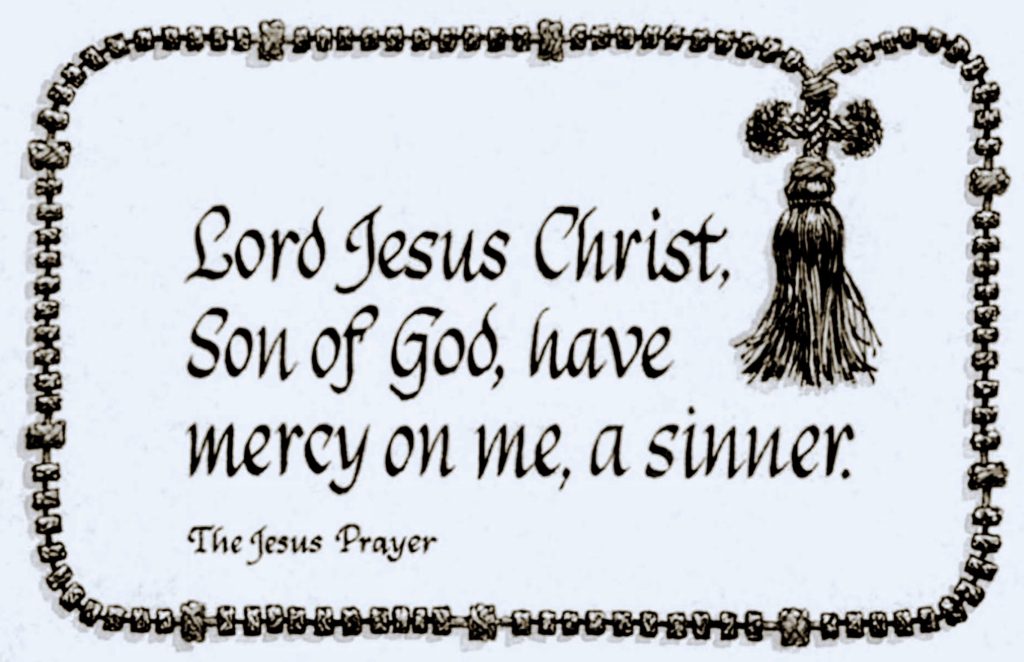
My spiritual mentor Bishop Simon Barrington-Ward commended to me a short prayer that can be used repeatedly as we go about daily life called the Jesus Prayer about which, for those of us who go online I have posted a short talk on YouTube https://tinyurl.com/FrJohnSpiritualDirection. It reads: ‘Lord Jesus Christ, Son of God, have mercy on me a sinner’. “Lord Jesus Christ, Son of God” expresses faith in who Jesus is. “Have mercy on me a sinner” expresses our need of his salvation. The Jesus Prayer from Eastern Orthodoxy brings together Peter’s confession of faith and the Publican’s humble cry for mercy.
Paul’s letter to Philippi says, the name of Our Lord Jesus Christ is the name above every name. Repeating his name prayerfully brings us into contact with his presence. As a simple, memorable line of prayer it serves overactive minds. Instead of wrestling endlessly with distracting thoughts, we fill the mind with Jesus. The repeating of the prayer within ourselves draws us towards stillness and holds us to and permeates us with the mercy of God.
So let’s try it? Close your eyes, focus on the Lord, and quietly say with me: Lord Jesus Christ, Son of God, have mercy on me a sinner. Pause, breathe, and repeat it. Lord Jesus Christ, Son of God, have mercy on me a sinner. Maybe return to this prayer after you welcome Our Lord in Holy Communion.