As we ponder today Ezekiel 37 it is clear that the dry bones of Christendom need the breath of the Spirit to come from the four corners of the earth and hear the words ‘I will cause breath to enter into you and you shall live’. As with any body the Church will not stand without bones, hence the importance of church order in the Anglican and Catholic style with bishops, priests and deacons. Otherwise when the Spirit comes from the four corners of the earth it has nothing to mobilise and can amount to a lot of hot air.
I well remember Richard Hare, Bishop of Pontefract who used to address ecumenical gatherings with a bone. ‘Greetings’ he’d say ‘from the dry bones of the Church of England’.
This was years back when a powerful movement of the Holy Spirit was travelling across the churches. Pentecostalism with healing, speaking in tongues and so on was leaping across denominations through the charismatic movement.
The Church is a body and, if you like, the bones which order it and hold it up are bishops, priests and deacons who are ordained to guarantee the handing on the good news. Our problem was and remains a lack of apostolic vitality among our apostles so that often our bishops and priests lack Bishop Hare’s apostolic zeal and church life gets dry.
At the Pentecostal end there are problems because the Holy Spirit has something of a free for all given the lack of episcopal order. In his teaching from Ezekiel 37 Bishop Hare affirmed that the dry bones of Christendom need the breath of the Spirit to come from the four corners of the earth and hear the words ‘I will cause breath to enter into you and you shall live’. Yet as with any body it will not stand without bones, hence the importance of church order in the Anglican and Catholic style with bishops, priests and deacons. Otherwise, as Bishop Hare shared in a balancing criticism, when the Spirit comes from the four corners of the earth it has nothing to mobilise and can amount to a lot of hot air!
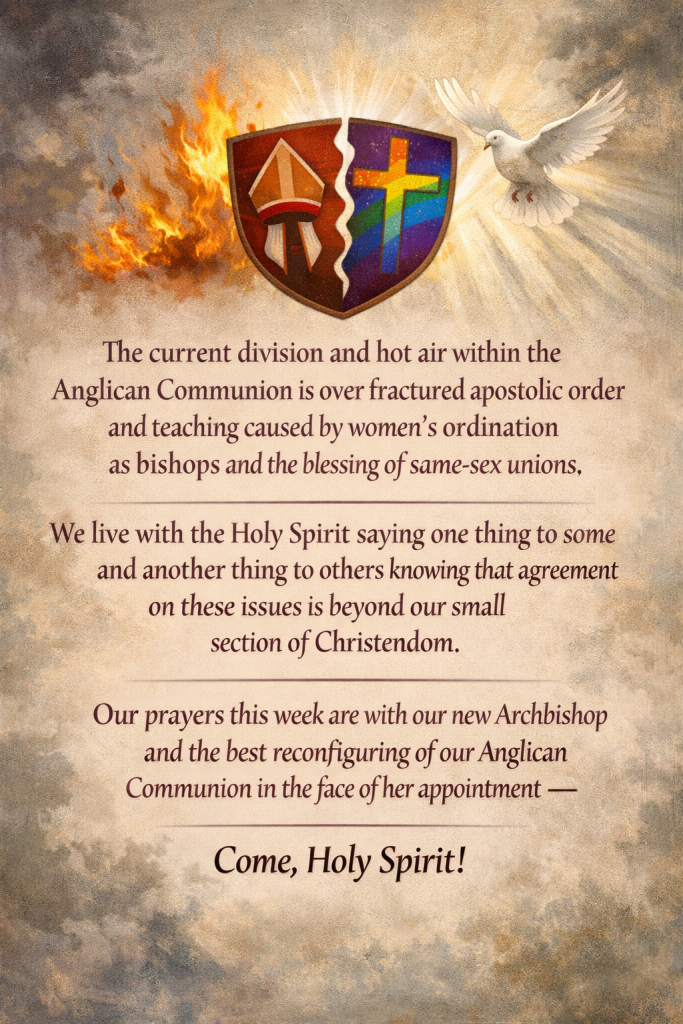
The current division and hot air within the Anglican Communion is over fractured apostolic order and teaching caused by women’s ordination as bishops and the blessing of same sex unions. We live with the Holy Spirit saying one thing to some and another thing to others knowing that agreement on these issues is beyond our small section of Christendom. Our prayers this week are with our new Archbishop and the best reconfiguring of our Anglican Communion in the face of her appointment – Come, Holy Spirit!
This morning’s readings which include the dry bones passage address more broadly the last line of the Creed, what it means to ‘look for the resurrection of the dead, and the life of the world to come’. They’re a scene setter for the dramatic events of next week when we recall the death and resurrection of Our Lord which establishes our future and that of the cosmos. At the heart of Christianity is no theory or doctrine but a happening – Christ’s resurrection. This happening connects with us individually and corporately and has been spoken of by the prophets. ‘Thus says the Lord God: I am going to open your graves, and bring you up from your graves, O my people’. It links to the beginning of faith in the resurrection of the dead on the last day affirmed in the Creed.
In our second reading from the letter to the Romans St Paul presents Christ’s resurrection in relation to the raising up of individual believers by the Holy Spirit, who through baptism gives life to our spirits, but in anticipation of the corporate resurrection to glory of believers on the last day. ‘If the Spirit of him who raised Jesus from the dead dwells in you, he who raised Christ from the dead will give life to your mortal bodies also through his Spirit that dwells in you’ (Romans 8:11). Even if our bodies remain subject to sickness and decay our sense of the Spirit indwelling us as believers renewed today in Holy Communion hints at an inner life that’s immortal. Healings and answers to prayer we experience in our lives over the course of earthly life are further manifestations of that resurrection life
The Gospel from John 11 is read today because it immediately precedes the events of Palm Sunday. Indeed the very sensation of the raising of Lazarus in St John’s account sets in train events which lead to his crucifixion. The story shows us both God’s compassion and power with Jesus weeping over his friend’s passing and raising him from the dead. It is Our Lord’s greatest miracle going beyond two other similar miracles with Jairus’ daughter and the widow of Naim’s son. The daughter had just died. The widow’s son had died probably earlier in the day as Jewish laws require interment within 24 hours. Lazarus had been dead for four days. Before raising his friend Jesus says: ‘I am the resurrection and the life. Those who believe in me, even though they die, will live, and everyone who lives and believes in me will never die’. (John 11:25-26) This statement is one of intent. Jesus acts upon it in three ways, praying effectively for Lazarus to be raised, going to his own death and then opening up a permanent resurrection in soul and body for all who live believing in him, individually and corporately.
The whole point of Christian faith is this opening of humanity to a dimension of life beyond this world that will be finally revealed ‘in the resurrection of the body and the life everlasting’.
Anne and I acted on this big picture of things when we agreed our bodies be laid to rest after death in St Giles’ Churchyard in Horsted Keynes to await that general resurrection alongside the mortal remains of many friends in that community. Easter could be a time to revisit our funeral arrangements in thoughtfulness towards those who will have to act for us after our death. ‘Our friend Lazarus has fallen asleep, but I am going to awaken him’ Today’s Gospel shows God’s viewpoint on the grave as a place of sleep, a sleep from which he can and will awaken us. The quietness of our cemeteries continues in anticipation of that awakening.
In Christian tradition there are two resurrections for believers. There is an individual resurrection of the soul at the moment of death and a general resurrection of the body that is part of the completion of God’s plan at the Lord’s return when the destinies of individuals finally become part of the corporate resurrection when, as Paul puts it again, God will become ‘everything to everyone’ (1 Corinthians 15:28). Scripture witnesses two ultimate destinies, heaven and hell, populated by people in body as well as soul. The catholic tradition affirms an antechamber to heaven where unrepented sins are dealt with called variously purgatory or paradise.
Christianity centres on the body of Christ. Believers are part of that body. They are incorporated by baptism and in an ongoing manner through holy communion. The resurrection body is a fulfilment of this incorporation. Jesus promises that ‘those who eat my flesh and drink my blood have eternal life, and I will raise them up on the last day’ (John 6v54). In the same way Paul teaches in today’s passage that ‘the Spirit of him who raised Jesus from the dead dwells in you… giv[ing] life to your mortal bodies (Romans 8v11). The joy the Lord gives to our spirit is destined to expand and fill the universe in the resurrection of the dead at his return.
As we prepare for Easter and the renewal of our baptismal promises we seek a fuller surrender of our lives to the God and Father of Jesus who has prepared for us good things that pass our understanding. Our priests are available before Easter for counsel or confession or prayer for individuals to serve that surrender. With Martha in today’s Gospel let us make an act of faith: ‘Yes, Lord, I believe that you are … the Son of God’. May the devout celebration of Christ’s death and resurrection bring death to more of our sins, fresh life in the Holy Spirit to counter our dryness and a more confident looking forward to ‘the resurrection of the dead, and the life of the world to come’.