The author introduces readers to Brighton—the site of the 2025 European Forum Conference—and uses that popular destination on the English south coast as an example to illustrate a plea for strategic tourism. He discusses how such an approach to being a tourist can enhance one’s experience and help counter the damage caused by the overtourism that affects so much of Europe and other popular sites.
In the summer of 2025, the Delta Kappa Gamma Society International held its European Forum conference in Brighton, England. One hundred educators from eight European nations and two North American countries gathered in one of
the United Kingdom’s main tourist resorts, famous for its Pier, Pavilion, The Lanes, and Racecourse. The conference venue gave the opportunity for delegates to walk up the adjacent South Downs and embrace a full vision of the city of Brighton.
As a local writer and broadcaster, I have a passion for communicating the riches of a locality such as Brighton and ways of seeking space in and around the city that expand the spirit, extend knowledge, and deepen wisdom. Visitors are many, yet many come and go without the education to be gained that a strategic approach to tourism invites so as to benefit both tourist and venue. Strategic components include
communication of historical, cultural, and artistic background and of environmental issues—not the least of which is minimizing carbon footprints.
Privileged to work once in South America as pastor of indigenous people, I saw the hurtful consequences of insensitive tourism alongside the blessings received by visitors who engaged with the rich, age-old Amerindian culture. On family tours to Europe, my wife and I balanced visiting “must see” locations with strategically placed residence and local engagement where we could breathe in the atmosphere and quality of life away from tourist “hot spots.” Resident in the south of England for the last 30 years and a keen walker, I have applied my gifts as a writer to serve a contemplative yet educational approach to walking in North London, Haywards Heath, and Brighton, describing routes with linked short stories from local history. In my Thirty Walks from Brighton Station (Twisleton, 2025), I recently commended a wider choice of sights beyond the “must-see” destinations in Brighton to encourage this strategic approach.
Today’s city traces back to an age-old fishing community transformed in the 18th century by Richard Russell’s discovery of the curative power of sea-bathing. Though I bathe rarely in the sea, on each visit to Brighton I appreciate the oxygen-rich “sea air.” The Prince Regent (1811–1820, later King GeorgeIV) stamped his mark on Brighton through building the Royal Pavilion, finalized 1815–1822 by John Nash. With the railway’s arrival in 1841, Brighton started to belong to everyone, chiefly day visitors, and became “London-by-the Sea.” The resurgence of creative employment and ease of the commute north has more recently led to renaming London “Brighton-inland.”
During the COVID-19 lockdown, I set out with friends and family to discover Brighton on foot, which led me to publish my book commending 266 easily accessible sights accessed along 30 routes: some circular, others exploiting public transport, and all of low carbon footprint. My walking was allied to a local history project identifying sights that tell stories that educate both residents and visitors about Brighton and Hove. In writing, I had in mind the thousands I see in summer descending to the sea for fish and chips, a walk along the Pier, and a ride on the mini-train, activities one can undertake in many seaside resorts. I sought to introduce visitors to Brighton’s rich history and current service of the environment in the reduction of carbon footprints. Besides serving visitors and those seeking exercise, Walk books (Twisleton, 2001, 2020, 2025), in taking people around a place, provide varied perspectives on it, serving community cohesion. Communities get amnesia, and cities with fast-changing populations are prime candidates. Celebrating how people came to be where they are helps maintain a healthy community. Discovering heritage builds confidence in a community to face the future in a world that centers on the “mini world” of family and “mega world” of media—often to the detriment of the “midi world” of locality.
Deciding where to go and what to do on a visit to Brighton requires the wisdom to balance “must-see” and “worthy of a visit” options. The Royal Pavilion is a “must-see” in Brighton. During World War I (1914–1918), it housed wounded Indian soldiers. Some “brought in unconscious, waking up amid the fantastic Asian decorations of the ceilings imagined they had died and were waking in Paradise” (Musgrave, 2011, p. 354). One of the walks commended in my book is to the Chattri, a small domed monument on the Downs near Patcham dedicated to the memory of the Indians who died at the Pavilion and built on the site of the burning ghat where their bodies were cremated. Visitors to Brighton have easy access to the South Downs above the city, with features such as the Chattri and Truleigh Hill, where there is a more futuristic association. Electricity from the 2018 Rampion Offshore Wind Farm, so clearly visible from its heights, passes under the hill to power half the homes in Sussex. The Chattri’s worthiness links to the Pavilion as “must-see,” while a trip up the Downs to reflect upon the wind farm is “could-see” and also reduces environmental impact on the city itself.
The challenge of tourism to Brighton is familiar in many places across the world. A large flow of visitors puts a strain on resources such as electricity and water and drives up housing costs, impacting residents and their families as it congests the flow of motor and people traffic and increases noise pollution. Looking more widely, tourists can leave a huge carbon footprint. Providing information about and guides to less-visited parts of a tourist venue spreads the benefit visitors bring over a wider area and so addresses the logistical challenge of people all heading to one place such as Brighton Pier.
Neath (October 11, 2024) covered the challenge of overtourism in Brighton common to many European resorts: A travel executive has floated the idea of introducing a tourist tax within Brighton to stop overcrowding and pollution in the coastal city; however, the council claims that they welcome tourism, and they are not challenged
by their large numbers. Brighton attracts visitors each year for its eclectic seaside culture, LGBT+ scene, vibrant nightlife, and an array of independent shops, restaurants, bars, and art galleries that are woven among the Lanes. However, is the
climbing number of tourists post-pandemic putting a strain on the city and the local residents? Caroline Cartellieri, a non-executive Director at Europ Assistance, a travel insurance and assistance company, suggested that a tourist tax charging day-trippers visiting Brighton could potentially quell tourism issues in the area. “As overtourism continues to challenge popular UK seaside destinations like Brighton, innovative solutions are crucial.” (para. 1–4)
A tourist tax for Brighton? The blessings tourists bring are being weighed against the cost of their deleterious impact with the heavy traffic down the A23 and by railway from London, disgorging 11 million visitors to the city annually. Worldwide “tourist destinations collaborate more to spread their visitor load by promoting alternative or less-frequented sights such as a local Incan archaeology dig instead of Machu Picchu, a lesser art gallery instead of the Louvre, or Ravenna instead of Venice. Brighton is a middle-sized tourist destination. It would be a good alternative to London, Bath, Oxford, or Stratford. It, too, needs some relief, which adjacent, smaller-sized destinations could provide.
“Welcome to the vibrant city of Brighton and to this extraordinary event. Let’s make it a memorable one!” (The Delta Kappa Gamma Society International, 2025, p. 6). Brighton proved a memorable venue for DKG attendees, and, through the author’s conversation with a delegate, it became an inspiration for this exploration of educational challenges associated with overtourism. Tourist venues are served in protecting their ethos by a strategic approach spreading the load of visitors through educational projects that build pride in their history, geographic awareness, and environmental consciousness among both residents and visitors.
References
The Delta Kappa Gamma Society International. (2025). DKG European Forum Conference brochure. Author.
Musgrave, C. (2011). Life in Brighton. History Press.
Neath, A. (2024, October 11). Brighton tourist tax debate ignites amid overcrowding claims – as council insists they welcome visitors. The Independent (UK). https://www.the-independent.com/travel/news-and-advice/brighton-tourist-tax
-overcrowding-uk-b2627637.html
Twisleton, J. (2001). Forty walks from Ally Pally: A practical handbook for seeking space in North London (2nd ed.). Fiennes
Print.
Twisleton, J. (2020). Fifty walks from Haywards Heath: A handbook for seeking space in Mid Sussex. Author.
Twisleton, J. (2025). Thirty walks from Brighton Station: Catching sights and sea air. Author.
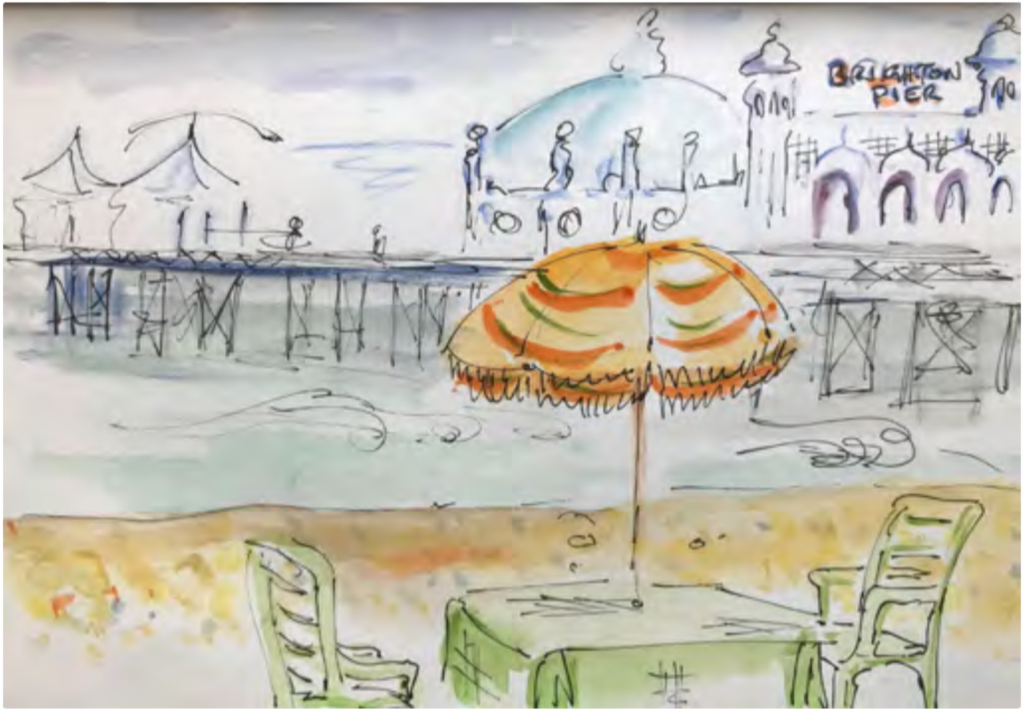
”Brighton Pier” by Anne Twisleton, wife of the author