How do you see God? I see him as all-powerful love surrounding me and you and all he’s made at all times, whether folk know or don’t know what Paul describes today as ‘the free gift in the grace of the one man Jesus Christ’. In Lent we centre, and the readings centre, on what God’s done for us in Jesus. The first two readings from Genesis 2 and 3 and Romans 5 go to the very heart of Christianity. Their truth is summed up in two verses of Newman’s hymn ‘Praise to the holiest’: ‘O loving wisdom of our God! When all was sin and shame, a second Adam to the fight and to the rescue came. O wisest love! That flesh and blood, which did in Adam fail, should strive afresh against the foe, should strive and should prevail’.
How do you see God? I see him as all-powerful love surrounding me and you and all he’s made at all times, whether folk know or don’t know what Paul describes today as ‘the free gift in the grace of the one man Jesus Christ’. In Lent we centre, and the readings centre, on what God’s done for us in Jesus which is the second question I would address this morning: What light does Jesus Christ shed on God?
With these two questions in mind I want to look with you at the first two readings today from Genesis 3 and Romans 5 which go to the very heart of Christianity.
Their truth is summed up in two verses of Newman’s hymn ‘Praise to the holiest’:
‘O loving wisdom of our God! When all was sin and shame,
A second Adam to the fight and to the rescue came.
O wisest love! That flesh and blood, which did in Adam fail,
Should strive afresh against the foe, should strive and should prevail’.
These verses sum up the analogy between Adam and Christ presented in the second scripture reading building on the first which I invite you to look at again with me in our booklet.
First the Genesis 2 and 3 reading from the very start of the Holy Bible show. It expresses in magnificent poetry the great truths of creation and fall. If we find light on God from Jesus Christ it is, as the Romans passage indicates, in the saving significance of his death and resurrection we celebrate at Lent and Easter. Genesis tells us we are God’s creatures yet fallen creatures. Something has gone wrong with us. We’re not what God intended us to be.
Take a minute to read through the passage again on your own, Genesis 2.15-17 and 3.1-7.
I wonder what you felt? Especially the ladies? A few thoughts.
- The Hebrew word for man is “adam” so even if the author intends it as the name of an individual first man we’re in order to see it as the personification of Everyman. Adam’s story is our story, as is Eve’s.
- We should not press her role in the story as it’s been pressed in the past, when woman was blamed for the Fall more than man being the one deceived by the serpent. In the Romans passage Paul says nothing about Eve and actually blames all on Adam.
- Man and woman are jointly responsible for their fallen condition and can’t blame God or the devil for it – we’ve made and continue to make wrong choices that head us away from what God intends us to be.
- Whilst our wrong choices weigh against us, and our fallen condition makes it harder to choose rightly, scripture makes clear in this story that we’re still responsible for our actions.
Let’s go on to the second reading Romans 5 in the booklet which takes up the account of Adam’s fall we’ve just looked at and balances it with the restoration God has given us in Jesus Christ so that we can experience his redeeming love.
It’s not an easy passage I’m afraid. Here are some thoughts:
- It starts with a clear truth: ‘Just as sin came into the world through one man, and death came through sin, [and ]so death spread to all because all have sinned’ and then there’s a massive digression which we could have removed for reading in Church, lines about the period between Adam and Moses when, since there was no Law people, weren’t technically accountable.
- Reginald Fuller’s commentary on the Sunday Lectionary takes up this loss of thread in Paul’s argument in Romans 5 and suggests this helpful summary of the passage: ‘As Adam began a history of fallen mankind, characterized by sin and death, so Christ began a new history of mankind characterized by acquittal, life and righteousness. Yet it is not an analogy in which both sides are of equal weight… Christ’s achievement is far greater than Adam’s… death was negative, life is positive. Death’s dominion enslaved man, Christ’s dominion sets him free’.
All of which brings me back to John Henry Newman’s summary on the fall and redemption from Dream of Gerontius I mentioned earlier:
‘O loving wisdom of our God! When all was sin and shame,
A second Adam to the fight and to the rescue came.
O wisest love! That flesh and blood, which did in Adam fail,
Should strive afresh against the foe, should strive and should prevail’.
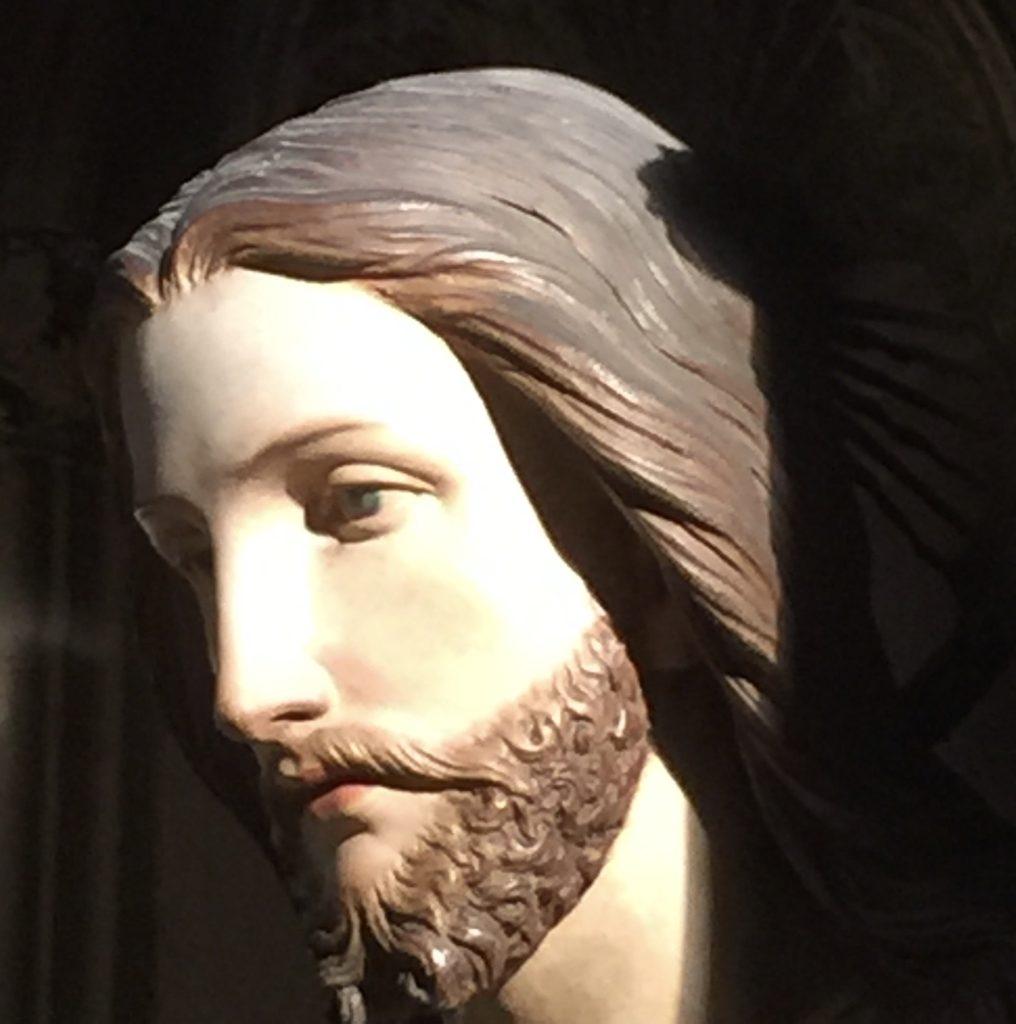
What light does Jesus Christ shed on God? Read Romans or sing Praise to the holiest to capture the light he sheds, or use this four liner:
God made us for friendship (hold hand upwards).
Sin came in as a barrier (place bible on hand as symbol of the barrier),
Christ died to lift the barrier (lift bible off hand)
Making us friends with God (raise hand up again)
To know that friendship, to sense the love that lies over us and around us and beyond us in heaven, we need Jesus! We need to see how in the words of John 3.16 ‘God so loved the world that he gave his only begotten son so that all who believe in him should not perish but have everlasting life’.
The world around us finds it easier to believe in Genesis 2 and 3 than Romans 5. I wonder what Queen Mary who once sat there point would make of the arrest of her great grandson? Reasonable folk admit the effects of our fallen-ness but they miss out on that which goes beyond reason, which is the very good news that brings us to Church on a Sunday. Paul describes this news today in Romans as ‘the free gift in the grace of the one man Jesus Christ’ and elsewhere in 1 Corinthians 15.22 he uses these words: ‘as in Adam all die, even so in Christ shall all be made alive’.
We’re given the Lent challenge, forty days of training, to help us come more alive to Jesus Christ and see the power and direction of God coming more to bear upon the world through the exercise of our faith in prayer, study and good works.
As we go to his altar this morning we go seeking a fresh anointing in God’s love which seeks to touch the centre of our being in the consecrated bread and wine of the eucharist.
How much God loves us – how we need Our Lord – Jesus who awaits us at St Mary’s altar rails!