As something God-given, personal faith is inevitably mysterious. Believers hold things together in their experience that live in tension from a rational perspective. Hence faith is both a virtue and a gift, a human act yet one prompted by God, a personal act yet inseparable from the corporate faith of the church. These paradoxes are captured in today’s Saint’s famous definition of faith: ‘Believing is an act of the intellect assenting to the divine truth by command of the will moved by God through grace’.
‘Suppose a person entering a house were to feel heat on the porch, and going further, were to feel the heat increasing, the more they penetrated within. Doubtless such a person would believe there was fire in the house, even though they did not see the fire that must be causing all this heat. A similar thing will happen to anyone who considers this world in detail: one will observe that all things are arranged according to their degrees of beauty and excellence, and that the nearer they are to God, the more beautiful and better they are’.
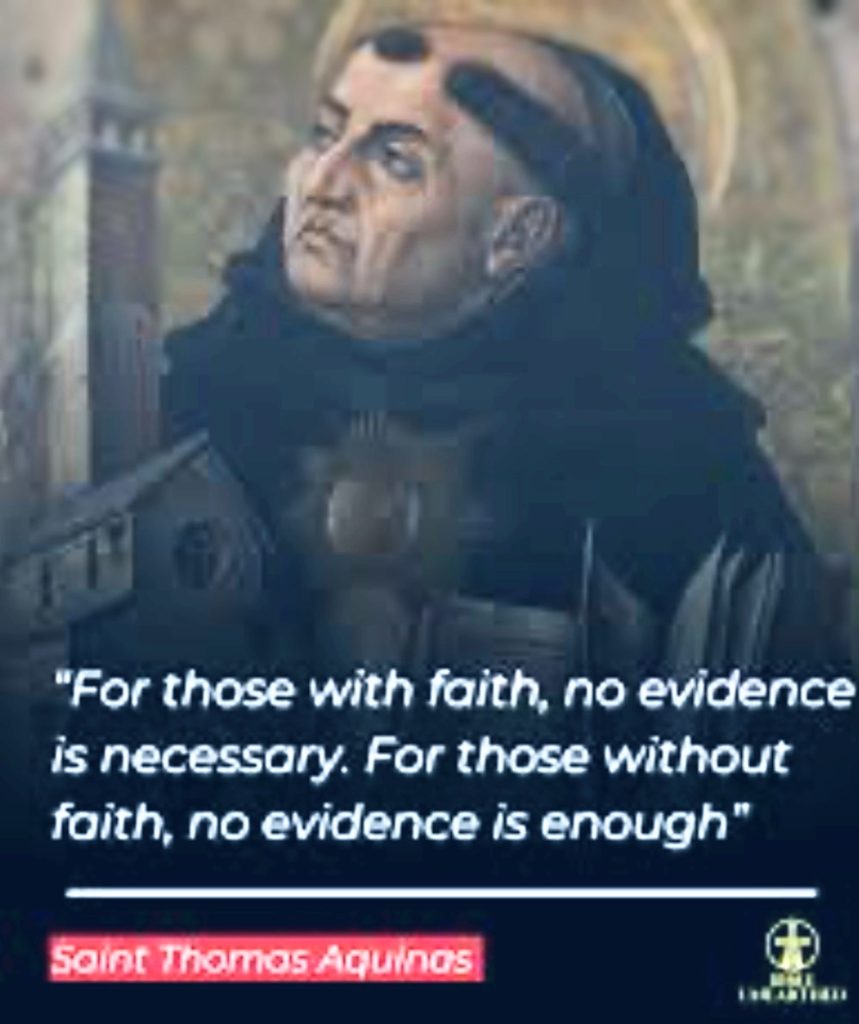
St Thomas Aquinas, whose Feast day it is, wrote these words in the thirteenth century marshalling arguments from the design of the world towards the proof of a creator. From what is good and true and beautiful he argues for One of perfect goodness and truth and beauty and links his reasoning to the revelation of God in Christ.
Aquinas saw how both reason and faith lift us up to God. His design argument for God is made with pure reason using the analogy of heat spreading from a fireplace . Today’s Saint was expert at putting faith into words once stating that the light of ‘faith wakens us to the mystery of God’.
Those words came back to me on a stormy sea journey when at one point on our crossing of the Channel the sun broke through the storm clouds. Light streamed on the turbulent sea reflected forwards in a scene of extraordinary beauty. You couldn’t look at the sun but you could feast on a remarkable display of light reflected from the moving waters. Their threatening look was changed into a scene of immense beauty. So, in Aquinas’s thinking, the light of faith transfigures life’s dark circumstances showing us God in the midst of it all. He saw his thinking as expanding the revealed text of scripture such as the words of Paul in 2 Corinthians 4:6‘It is the God who said, “Let light shine out of darkness,” who has shone in our hearts to give the light of the knowledge of the glory of God in the face of Jesus Christ’.
When I feel threatened by my circumstances I put faith in God. I ask for the light of faith in him to shine and change the look of things so I can persevere and do right. By that light I see beyond what’s facing me outwardly to God’s hand outstretched to me beyond those circumstances. As Aquinas writes in a hymn: ‘faith our outward sense befriending makes the inward vision clear’.
As something God-given, personal faith is inevitably mysterious. Believers hold things together in their experience that live in tension from a rational perspective. Hence faith is both a virtue and a gift, a human act yet one prompted by God, a personal act yet inseparable from the corporate faith of the church. These paradoxes are captured in today’s Saint’s famous definition of faith: ‘Believing is an act of the intellect assenting to the divine truth by command of the will moved by God through grace’.
There were few aspects of life and Christianity Aquinas didn’t set his mind to even extending his thought and analysis to where the joy of the saints might come from. To end, let me quote his description of eternal life which imagines that joy as coming from loving one another for ever so that in heaven the saints might be seen as rejoicing as much in the good of others as in their own good. I quote St Thomas Aquinas a last time: ‘Eternal life consists of the joyous community of all the blessed, a community of supreme delight, since everyone will share all that is good with all the blessed. Everyone will love everyone else as himself, and therefore will rejoice in another’s good as in his own. So it follows that the happiness and joy of each grows in proportion to the joy of all’.