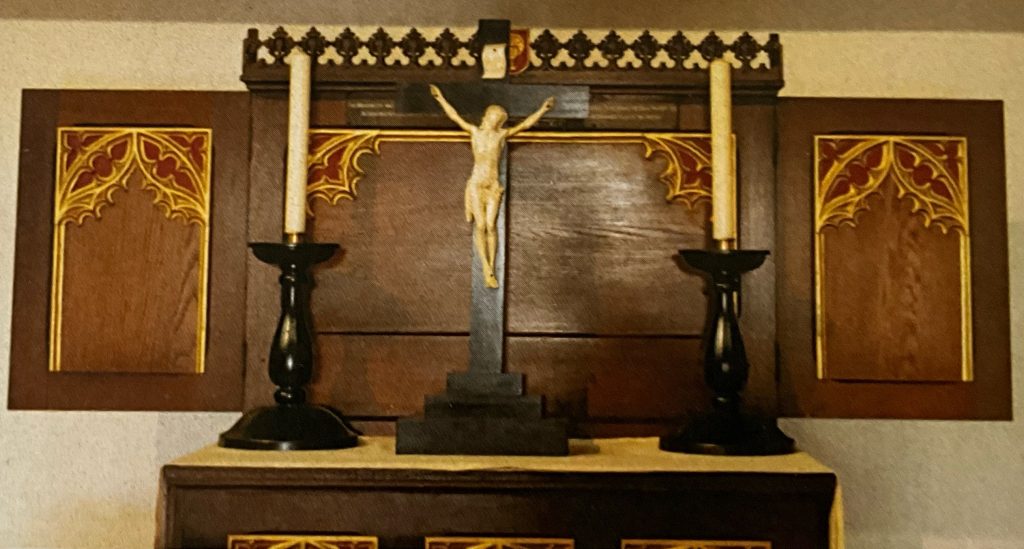
This is the ‘Field Altar’ at the back of St John the Evangelist, Burgess Hill where I serve as honorary priest.
It was used to celebrate the Eucharist on the battlefield by a previous parish priest, Canon Harry Burton.
Today’s scripture features the description of Jesus as ‘Lamb of God’ whose voluntary death once for all has continuing power to break the powers of sin, violence, war, and death.
Earlier this month Anne and I joined the Burgess Hill Heritage and History Association as part of my work writing a dynamic history of the town re-presenting some very good work over the years. This includes the Church History Trail (show) produced by Jane Hatt with Alan Seymour, John Orchard, Fred Avery, Deacon Stephen and Churchwarden Graham.
As the booklet explains, the theme of Sacrifice ‘plays out repeatedly’ in our Church building created in 1863 as part of the Gothic Revival. I have often mentioned in sermons the small Trefoil windows at the west end on ‘The Sacrifice of the Cross’ and ‘The Sacrifice at the altar’. Above these windows, created by Walter Tower mentored by the famous Charles Kempe, is the magnificent West Window installed in 1931. It portrays Our Lord as King but, as the booklet indicates ‘instead of holding the regalia associated with kingship, Christ holds emblems of the Good Shepherd’ who gave up his life for the sheep. Another two powerful features linked to Christ’s sacrifice are the Calvary from Oberammergau above the Rood Screen and the Field Altar used by former parish priest Canon Harry Burton on the battlefields of World War One.
We might think back to the soldiers who gathered around that altar uniting themselves, souls and bodies, with the movement of Christ’s self-offering. It is one of many striking images in St John’s linking the heart of the Christian religion to human reality as real in the trenches of Ukraine as it was then in the trenches of The Somme,
The heart of the Christian religion is this gathering in the parish church which is part of an eternal offering of worship stretching back to the foundation of the world and stretching forward to the consummation of all things.
‘Behold the Lamb of God’ we read in the Gospel. Our Lord is truly ‘the lamb slain from the foundation of the world’ whose sacrifice on Calvary, as Revelation 13 verse 8 envisions, draws forth in heaven ‘blessing and honour and glory and might forever and ever’.
This morning as we offer the Holy Eucharist we are touching reality – we are drawn to the event represented here that reveals a love touching every human concern upon the earth.
At the beginning of a challenging year for so many places the world over there is no more powerful action we can take on behalf of humankind than to plead Christ’s Sacrifice, offering God what is his own…on behalf of all.
To the outward eye we are a small gathering of religious people doing their own thing upon their weekly holy day.
To the eye of faith we are Christians, caught up once more, on behalf of the whole creation, into the eternal sacrifice of Jesus Christ, ‘through whom, and with whom and in whom in the unity of the Holy Spirit, we give glory to our Father in heaven’.
Here, as on Calvary, we see his body and blood separated in death and then transformed by power from heaven.
In every Eucharist we witness the separate consecration of Christ’s body and blood. We pause twice in the Eucharistic prayer to recall the sacrificial sundering of the Son of God – ‘this is my body…this is my blood…of the new covenant, which is shed for you and for many for the forgiveness of sins’.
‘Behold the Lamb of God’ their priest says lifting up the consecrated Bread and Wine.
There is a Church in Norway which has the image of a sheep sculpted half way up its tower.
Only when people enter that Church and hear something of its history do they discover the full Christian significance of the sculpted sheep.
Years before the sculpture was erected some renovation work was occurring on the Church steeple in this rural community. One day a workman slipped from the steeple to almost certain death. At the same time by a remarkable twist of providence a flock of sheep was being driven past the Church.
The steeplejack fell on a sheep and his fall was cushioned. The sheep died to save him – an awesome happening! The workers expressed their gratitude to God by adorning that Church tower with a sculpted sheep. It was welcomed as a powerful symbol of Christian Faith.
Jesus is the Lamb of God whose voluntary sacrifice takes away our sin. Our Lord on Calvary takes the full impact of sin and death for us at the cost of his life.
Jesus died in my place so that he might live in my place.
Jesus died in my place to carry off the impact of evil upon me, particularly through the gift of the Eucharist.
Jesus lives in my place, cooperating with my will by his Spirit, as I welcome him again and again into my heart in this Sacrament!
This morning we make the memorial of the Offering of Jesus and enter into that Self-Offering!
It is through the sacrificial Lamb of God that we can make a perfect offering to the Father, ‘our sinful bodies made clean by his body..our souls washed through his most precious blood’.
How much God needs the offering of our lives for his work here in Burgess Hill and its surrounds!