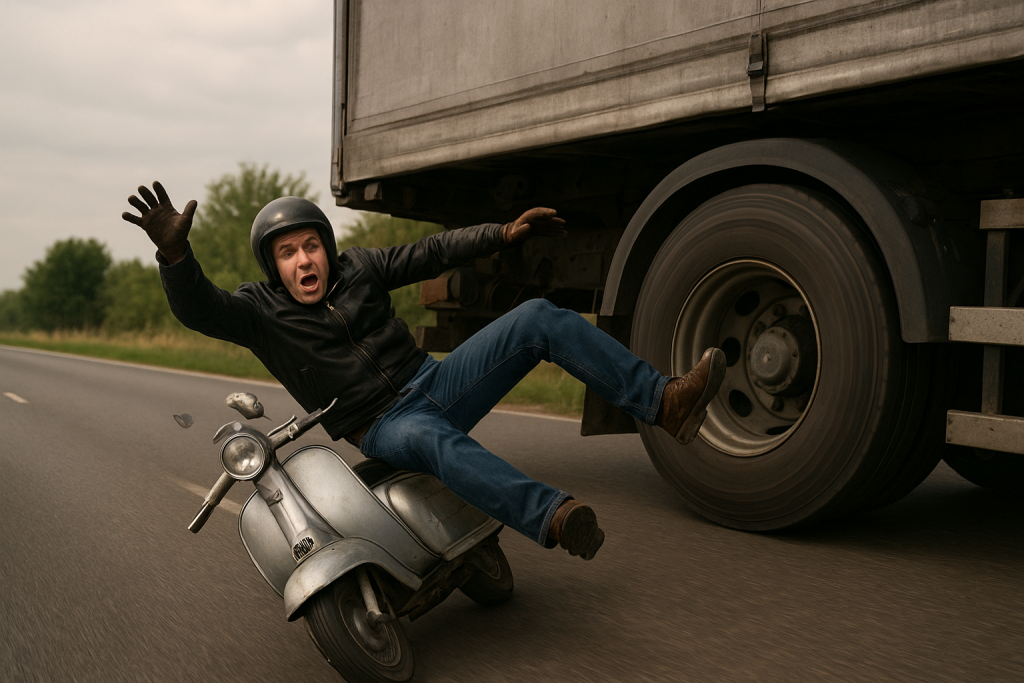
55 yrs ago, aged 21, I crashed my Lambretta—front tyre burst, I slid under a lorry & thought I’d die. Amazingly, I survived with sprains. It shook me so much I left science for the priesthood. Fitting it was St Michael & All Angels’ feast—heaven felt very near. 🙏
‘May the angels lead you into paradise; may they receive you and with Lazarus, once poor, may you have eternal rest’.
Those beautiful words from traditional funeral liturgy capture movement of the soul from earth to heaven parallel to the carriage of the body to earth. They are built from today’s Gospel of Dives and Lazarus and they provide opportunity for reflection on our ultimate destiny as believers.
In the Gregorian chant for this closing rite of a funeral Eucharist the melodic highpoint comes on the name of Lazarus, the poor beggar in Our Lord’s parable. The musical lifting is pointer to the poor man’s lifting, Lazarus ‘was carried by the angels to be with Abraham’.
In today’s parable Our Lord takes an age old story of the reversal of riches and poverty in the afterlife to challenge ‘those among the Pharisees who loved money’ reminding us how those who care nothing for those less fortunate than themselves will receive harsh judgement from God in the life to come. It’s an uncomfortable piece of scripture underlined by today’s first reading from Amos challenging those who lounge in luxury. I do quite a bit of such lounging, at times in front of 24-7 news, before scenes of poverty and famine. Sometimes I give a donation but I’d have no money left if I acted proportional to such pictures. Scenes like Gaza thankfully have impacted the conscience of our nation which last week gave recognition to the state of Palestine in a challenge to the terrible status quo. How many poor, like Lazarus, are led daily by angels through death into Abraham’s bosom. How many, like Dives are led the other way into condemnation?
Today’s scripture provides an occasion to look at the Church’s teaching on the afterlife, expressed in the last words of the Creed, ‘the life of the world to come’ and in particular the ministry of angels. Tomorrow we keep Michaelmas, the Feast of St Michael and all angels. On that day 55 years ago, just 21, I was travelling on my Lambretta from Harwell, where I’d completed some neutron scattering on a polymer specimen, to Oxford to serve at the Eucharist in honour of the angels. As I drove along the front tyre blew and despite repeated application of front and rear brakes the vehicle veered across the road into the path of a lorry. I said what I thought were my last prayers. Amazingly I passed just in front of the lorry landing on the kerb with a sprain to my thumb and shoulder and lived to tell the tale. Coming so close to death made for a fuller evaluation of the significance of my life. It contributed no doubt to a radical career switch a few years later from polymer scientist to parish priest.
My interrupted journey – it entailed a brief visit to hospital – pointed me beyond my own pursuit of truth as a scientist to Truth’s pursuit of me. Heaven came close. It became more real to me, especially as the accident occurred on 29th September, tomorrow’s Feast of St Michael and All Angels. As for many, God became real to me not through thinking or feeling but through circumstances that stopped me literally in my tracks. It was natural to interpret my survival to divine intervention through an angel steering my scooter a shade. I lived on, and continue to live on, aware of an unseen realm, how it pierces through on occasion into our life experience, especially at the Eucharist, and will accompany us as we look to the Lord on the day of our death.
‘May the angels lead you into paradise; may they… receive you and with Lazarus, once poor, may you have eternal rest’.
A few thoughts to conclude on the Christian doctrine of judgement.
Can there really be a final catalogue of wrongdoing? Surely there can! As surely as a computer memory contains a million records, the memory of God is established. To him all hearts are open and all desires known. Furthermore, and this is the good news Christians know, by his sharing in our nature and his boundless compassion Jesus Christ is well appointed to judge the living and the dead. Did he not welcome and put the best slant on thieves and prostitutes, always ready to treat people as better than they were? As believers in such love can we fear meeting Our Lord face to face?
Christian tradition distinguishes an individual judgement at the moment of death and a general judgement which completes God’s righteous task at the Lord’s return when the dead are raised in body as well as soul. After death scripture speaks of two ultimate destinies, heaven and hell, although there is a qualification that no one dying with unrepented sin can face the Lord without cleansing, since no unclean thing shall enter his presence as stated in Revelation 21v27. This is the origin of the doctrine of purgatory which speaks of the need for the faithful departed to be purged or cleansed of residual sin to come close to God.
Today’s Gospel reminds us of the judgement ahead for every human being. Our minds argue against it because they think they know best. Actually, God knows best in the end. When we look into the eyes of Christ at his return there will be pain, but an ‘if the cap fits wear it’ sort of pain. Purgatorial pain may be as short as that. Our wrong actions affront God in his holiness but he has given us a remedy in repentance. Hell, refusal to face God, will be our choice. As the video of my life is prepared for showing on judgement day Christ has power to edit out the unacceptable points if I give them to him. Mercy triumphs over judgement when we allow Christ a place in our hearts!
‘There is no condemnation for those who are in Christ Jesus’ we read in Romans 8v1. God looks on those who are in Christ with the same love with which he looks upon his Son. Judgement has in a profound sense been passed already for those who have accepted God’s judgement on their lives. To accept one’s sinfulness and inadequacy is in the Christian tradition the pathway to joyful freedom. Such acceptance springs from the vision of God given in Jesus Christ we celebrate at every Eucharist, vision of a God of majesty, yes, but also a God more concerned to give us what we need than to give us what we deserve.
To believe in Jesus Christ who ‘will come to judge the living and the dead’ is therefore to face the future with an infectious hope. If faith shows you that the whole world is in God’s hands, so is its future. Christianity provides a deep sense of certainty that any perceived triumph of evil will be seen ultimately as an illusion. All will come right in the end because in the end there will be the grace and truth of Jesus Christ (John 1v14, 17). Ultimately there will be grace – mercy – for repentant sinners and truth to prevail over all who live and act deluded by falsehood.
‘Therefore, with angels and archangels and all the company of heaven’ we ascribe to God, Father, Son and Holy Spirit, all might, majesty, dominion and power henceforth and evermore. Amen